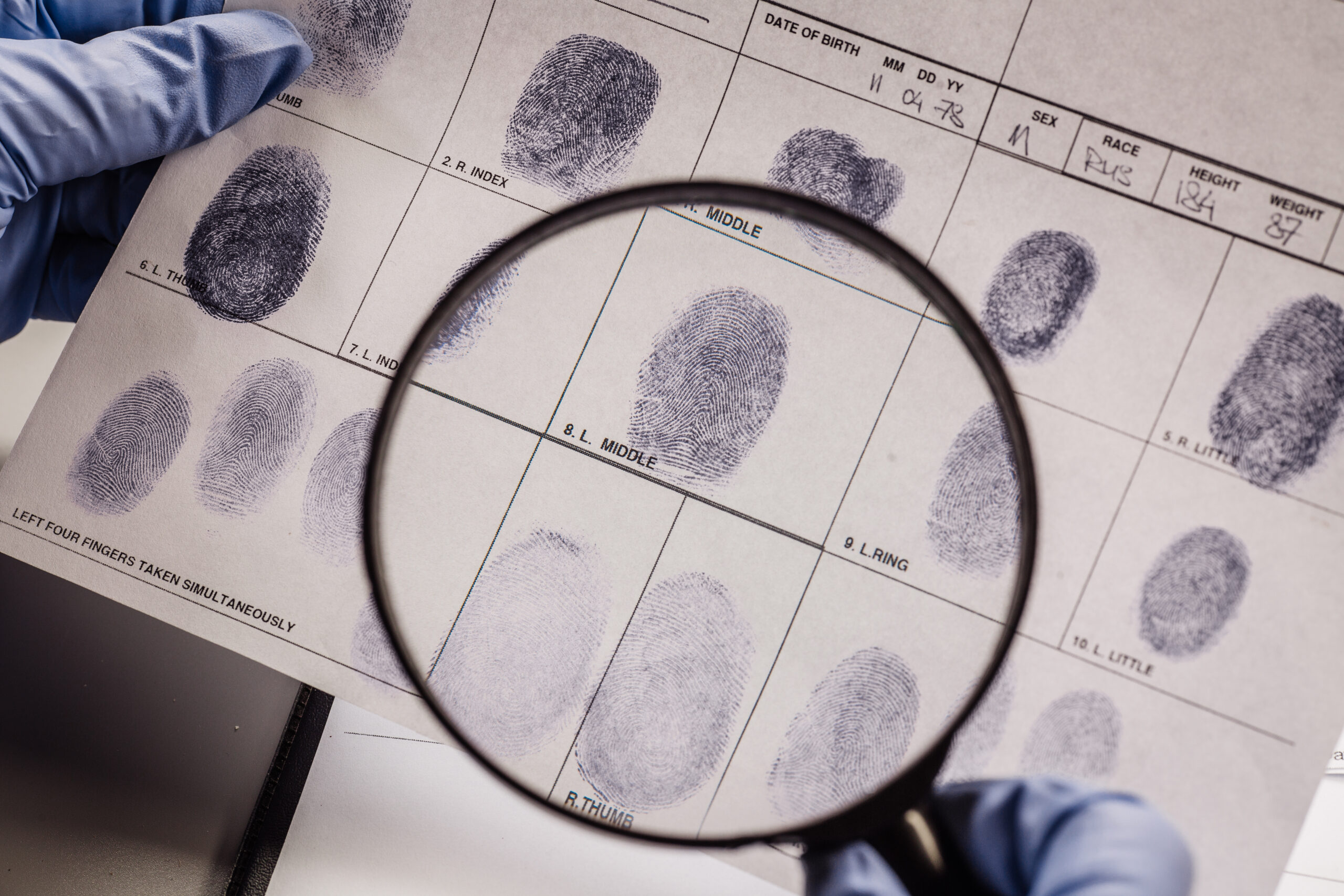
Created in 1987,the Automated Fingerprint Identification System (FAED, France) stores various types of data collected during judicial investigations. Its use, strictly regulated by law, was recently modified by a decree issued on April 23, 2024.
As of January 2024, the FAED contained the fingerprints and palm prints of more than 6.7 million individuals, as well as nearly 300,000 unidentified latent prints (CNIL data). Each year, over one million new records are added. This vast amount of information makes the database a valuable tool in criminal investigations, as its consultation allows investigators to establish links between cases or to identify missing persons.
More interconnections for greater efficiency.
The FAED is far from being the only existing database. France operates several others, including the TAJ (Traitement des Antécédents Judiciaires – Criminal Records Processing System), the CJN (Casier Judiciaire National – National Criminal Record), the DPN (Dossier Pénal Numérique – Digital Criminal File), and the FPR (Fichier des Personnes Recherchées – Wanted Persons File), each of which contains millions of data entries. Added to these are the police and gendarmerie procedural software systems, LRPPN and LRPGN, which enable the automated processing of personal data.
The decree, which came into force on April 24, 2024, aims to establish interoperability among these different databases, with the clear objective of facilitating cross-references and improving overall efficiency.
Enhanced European cooperation.
The project does not solely focus on the national level; it also aims to link these national databases with European systems, allowing access to their data repositories. This will notably be the case for the Second Generation Schengen Information System (SIS II), which includes a central unit based in Strasbourg, connected to national databases in each Schengen member state. This system centralizes information on individuals or objects reported by administrative and judicial authorities across the participating countries. Another beneficiary will be the Entry/Exit System (EES), which automatically records and monitors data relating to nationals of non-EU countries traveling within the Schengen area.
In both cases, this data sharing aims to facilitate information exchange, strengthen controls, and consequently enhance security within the European area, now free of internal borders.
Des données suffisamment sécurisées ?
The decree also modifies the retention period for data stored in the FAED. It is now set at twenty-five years for crimes and certain offenses, and may extend up to forty years for specific criminal procedures.
Given the vast volume of data processed and the new interconnections among databases, concerns naturally arise regarding the protection of personal information. Following a warning issued by the CNIL (Commission Nationale de l’Informatique et des Libertés – French Data Protection Authority), which had expressed concerns to the Ministry of the Interior, measures have been implemented to safeguard data confidentiality and to ensure the automated updating and deletion of records once their retention period expires. Whether these measures will prove sufficient remains to be seen…
A seasoned investigator deeply committed to solving cold cases, Raphael Nedilko describes them as “an equation with three unknowns: a complex case file, a family in total incomprehension, and an institution that remains largely deaf despite obvious goodwill at the individual level.”[1]
This is a perfect summary of an issue that continues to raise questions today. Victims and the justice system too often maintain relations as difficult as the case itself. The former cannot understand the inability to solve the crime or the disappearance and perceive only unjustifiable shortcomings. Overwhelmed by massive and urgent litigation, the latter recognizes its inability to devote time to old cases—serious, yes, but moribund in its eyes. It will invoke a lack of resources and an initial, fruitless investigation that would be pointless to reopen.
But what of the investigation that gave rise to the scandal? Is it not itself at fault, plunging families into despair and indignation? And does reopening or relaunching a case require a different treatment from an investigation that, by definition, concerns past events?
The initial criminal investigation: rigor is essential
It is often repeated in police academies and at the National School for the Judiciary (ENM): everything depends on the quality of the initial investigation. Truth lies in the rigor of crime scene observations and evidence collection procedures. These tasks are numerous and sometimes delicate, depending on the configuration of the crime scene. Three scenarios arise, from the simplest to the most complex:
• The crime scene is located in an enclosed space—house, apartment, or their outbuildings. The homicide has clearly taken place there and the victim’s body is present. The perimeter is easy to secure, greatly facilitating the investigators’ work. However, a risk remains: third parties (relatives, neighbors, emergency services, etc.) may have entered the premises before the investigators’ arrival, potentially contaminating the crime scene.
• The crime scene is in a public place. The victim has been killed in the street or in a vehicle (settling of scores). The perimeter is more uncertain and less easily secured, inevitably complicating the search for traces and evidence. The presence of bystanders may also interfere with the investigation. In addition, the event may generate public disorder, particularly if it occurs in a neighborhood prone to urban violence.
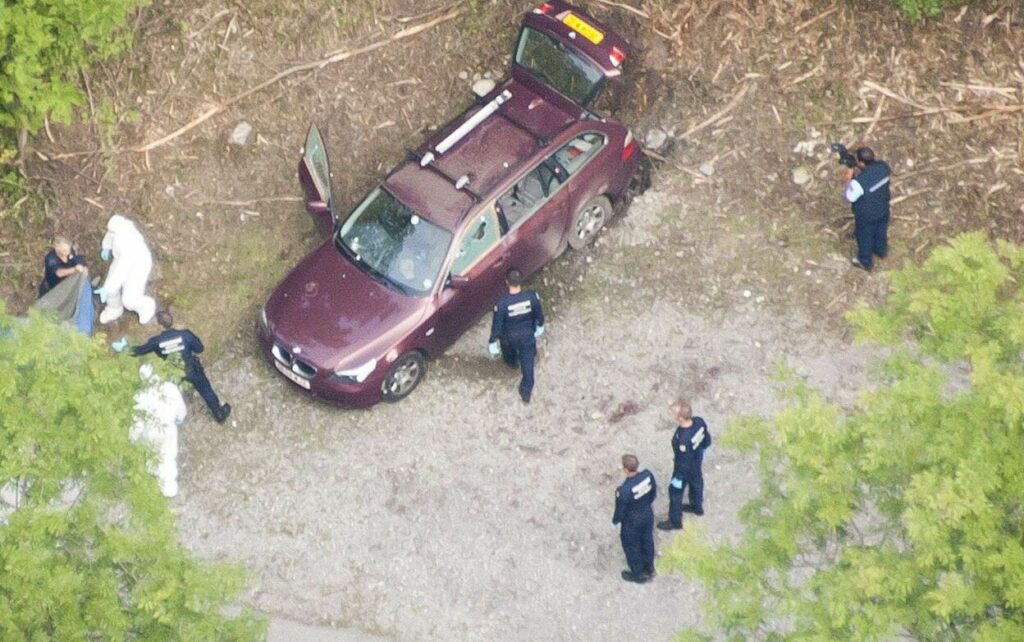
• The crime scene is uncertain or ill-defined. This is the most delicate situation for investigators. The body is discovered in a natural environment—forest, woods, dirt path, or aquatic setting such as a river, pond, or the sea. Defining the crime scene may be complex, if not impossible (e.g., an immersed body). Moreover, the presence of the body does not necessarily mean the murder took place where it was found. It is likely that the crime occurred elsewhere and that the perpetrators sought to dispose of the victim. This configuration makes the investigation particularly challenging, especially if the death occurred long ago.
The layout of the crime scene thus directly affects the conduct of the investigation. In any case, the investigative service must display the utmost rigor. It is well known that initial observations are decisive: any omission, oversight, or negligence will weigh heavily on the case. Establishing the truth may be compromised, with errors often proving irreversible.
The uncertainty surrounding the cause of death can also arise. It may be natural, accidental, criminal, or suicidal. Determining the cause ab initio is not always simple. An erroneous initial assessment can gravely distort the reasoning of both investigators and prosecutors. Mistaking a homicide for a suicide—or the reverse—can cause irreparable deficiencies or, conversely, unnecessary and time-consuming actions, whereas prompt investigations are crucial for preserving evidence.
“Solving a murder is a priority task that requires perfect coordination between investigators and magistrates.”
Jacques DALLEST
Careful observation of the location where the body is discovered, thorough and rigorous documentation, preservation of traces and evidence, meticulous collection, and methodical conservation—these are the fundamental recommendations that first responders must respect.
Unfortunately, insufficient staffing, inadequate training, poor equipment, culpable negligence, serious mistakes, and dangerous certainties all hinder the investigation. An incomplete neighborhood canvass, overly hasty interviews, unexecuted searches, and missing verifications likewise contribute to failures that seriously undermine the inquiry.
Magistrates must fully exercise their prerogatives in directing the investigation. The prosecutor involved at the outset and the investigating judge subsequently assigned to the case both play a fundamental role. The absence of precise directives for investigators, or a lack of diligence in case supervision, cannot be justified by an excessive workload. Admittedly, the criminal magistrate is above all a generalist, overwhelmed by urgent cases and daily pressures. However, criminal cases—particularly crimes involving loss of life—demand complete commitment and particular attention to the investigations conducted by the assigned service. Solving a murder is a priority task that requires perfect coordination between investigators and magistrates.
This necessary professional rigor must also account for the expectations of the victim’s relatives, devastated by a terrible tragedy and in deep distress. Distraught, they turn to justice, hoping for attention that is too often insufficient, if not absent. Even when acting as civil parties, they unanimously complain of being kept in the dark regarding the progress of the investigation—and worse, of not being received or heard by the investigating judge. Let us recall that Article 90-1 of the Code of Criminal Procedure obliges the judge to inform the civil party every six months on the progress of the investigation. The same text also allows relatives to be heard by the judge every four months upon their express request.
Sadly, these provisions are often forgotten. Civil party lawyers must insist on their strict application and act proactively in this regard. Too few actually use the rights granted to them by law, instead waiting passively for the investigating judge to summon them. This is most regrettable.
Is the judicial treatment fundamentally different when the crime remains unsolved? What means do investigators and the judiciary have at their disposal to pursue such cases—old, yes, but still profoundly painful for the relatives?
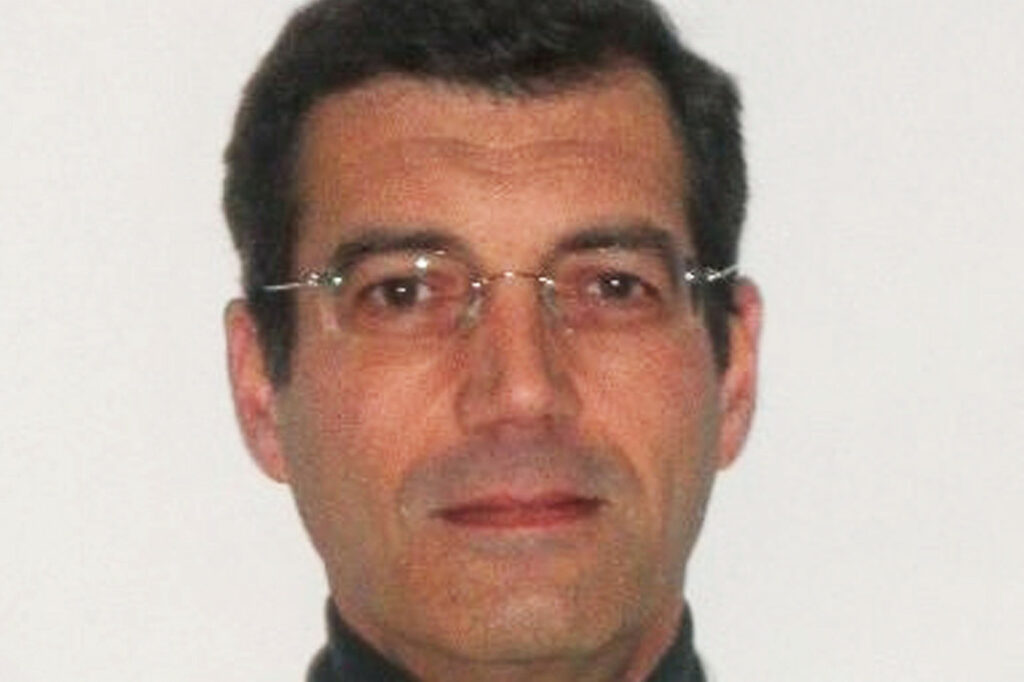
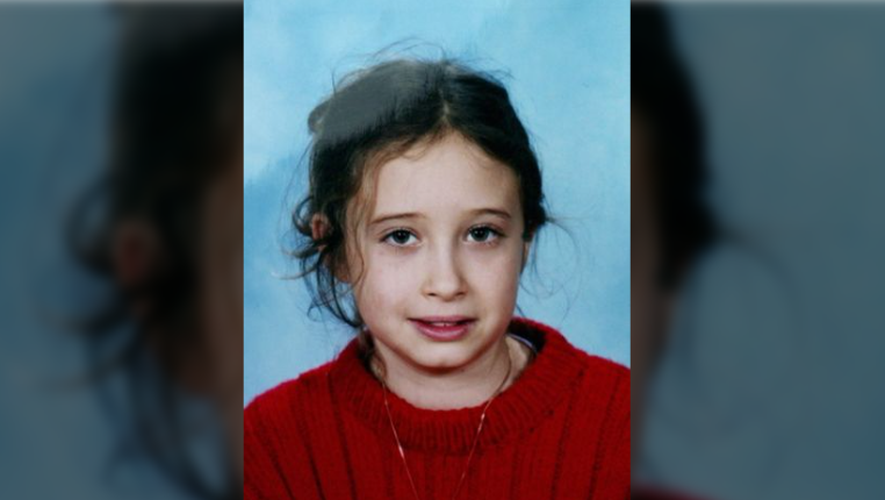
The Chevaline massacre case (2012)The Dupont de Ligonnès case (2011 The Caroline Marcel case (2008)The Estelle Mouzin case (2003)The Tiphaine Véron case (2018)Numerous judicial case files concerning unsolved cases have been transferred to the Nanterre Unit.
Cold case investigations: determination and empathy required
Reopening an old criminal investigation is a delicate task, all the more so when the facts remain unsolved. Past missteps weigh heavily on those tasked with solving the mystery. Forgotten witnesses, overlooked searches, neglected seizures, technical inquiries left aside, ill-suited strategies, and lack of commitment all lead to a dead end—an impasse from which it is difficult to escape. How many mishandled cases have resulted in perpetrators going unpunished? And how many murderers or rapists were able to reoffend simply because they were never identified?
The creation of the Specialized Unit for Serial and Unsolved Crimes (PCSNE), established within the Nanterre Judicial Court on 1 March 2022, has reshuffled the deck. Now, with the new criminal provisions introduced by the Law of 22 December 2021 (Title XXV bis, as incorporated into the Code of Criminal Procedure), the judicial handling of cold cases has gained a momentum that many hope will prove decisive.
The Nanterre Unit now has jurisdiction over violent and sexual crimes (murder, rape), as well as abductions and unlawful confinements committed—or likely committed—repeatedly, at different times, by the same individual against different victims, and more generally, over crimes whose perpetrator has not been identified more than eighteen months after their commission (Article 706-106-1).
Serial crimes and unsolved crimes are thus to be referred to Nanterre, regardless of where they were committed within French territory.
This represents a major step forward—long demanded by victims’ families—which helps restore their hope in justice. Composed of motivated, specialized prosecutors and investigating judges, the Nanterre Unit devotes all its energy to the exclusive handling of cold cases, thereby opening up new prospects for resolution. It is well known that, overwhelmed by urgent criminal matters and mass litigation, generalist magistrates can devote only limited time to old cases, however serious they may be. The first years of the Unit’s operation, and several notable successes, have demonstrated the value of a justice system focused on this highly specific area.
“At the same time, Prosecutors General and Public Prosecutors will have to establish a genuine criminal memory enabling them to know and monitor unsolved cases within their jurisdiction.”
Jacques DALLEST
A genuine “cold case culture,” born of the new law, must now permeate the judiciary. It is already clear that the Nanterre Unit will not have the material capacity to centralize all unsolved crimes in France, some of which date back more than forty years. It is therefore imperative that all Public Prosecutors and investigating judges handling criminal cases fully embrace this new and virtuous dynamic.
Taking genuine interest in these cases, developing tailored investigative methodologies, making use of modern investigative tools (such as artificial intelligence), mastering and applying new scientific disciplines (forensic sciences), reaching out to civil parties and listening to them, learning how to question suspects (behavioral analysis can assist here), forging links with foreign partners where necessary, and working with the media when appropriate—these are all avenues of effort that must guide magistrates in charge of cold cases.
Cold Cases – An Investigating Magistrate’s Inquiry – Jacques DALLEST – Mareuil Editions
At the same time, Prosecutors General and Public Prosecutors will have to establish a genuine criminal memory, enabling them to know and monitor unsolved cases within their jurisdiction. This memory is largely absent in prosecutors’ offices. Upon taking office, a prosecutor will not find on his or her computer a list of unsolved criminal cases, whether ongoing or closed.
Five tables should be regularly updated in the 91 prosecutors’ offices with a criminal division (out of 164 jurisdictions): murders against persons unknown, rapes against persons unknown, abductions and unlawful confinements against persons unknown, discoveries of unidentified bodies (including those buried under the designation “X”), and missing persons cases of concern. These tables would be communicated to the Prosecutor General (36 in France), who would periodically organize evaluation and monitoring meetings with the relevant prosecutors. A pooling of such data and exchanges could also be organized at the interregional level (several courts of appeal), so that each office has a panoramic view of crimes and disappearances recorded across this wider territory. Who can seriously believe that a criminal limits his actions to a single jurisdiction?
A criminal memory is indispensable to better identify violent and sexual crime, to address it with greater determination, to respond usefully to the expectations of relatives and their lawyers, and to be able to face media inquiries.
“One does not question a suspected murderer, possibly serial, in the same way as one questions a drug trafficker or a burglar.”
Jacques DALLEST
Seriously investigating a cold case also requires following these recommendations:
• Never destroy the case evidence, even if the case has been closed. A recent provision, effective 30 September 2024, prohibits any destruction within ten years after the expiry of the statute of limitations, i.e. thirty years after the case has been closed. Criminal evidence must be stored in a dedicated space, preserved in good condition, and carefully tracked. Losing a piece of evidence through negligence is unacceptable, as it may eliminate any chance of success.
• Give special attention to the victim’s relatives, the civil parties: receive them regularly, listen to them, carry out the acts they request, explain the progress and prospects of the case, and treat them simply with dignity. As Raphael Nedilko rightly says, it is a matter of honesty, honor, and humanity.
• Know how to conduct (or re-conduct) witness interviews, which can prove decisive. A sound methodology for collecting testimony is essential. The same applies to suspect interviews: one does not question a suspected murderer, possibly serial, in the same way as a drug trafficker or a burglar.
• Re-examine the work already carried out, not to criticize it as a matter of principle, but to identify shortcomings or omissions.
• Draw connections with similar cases or those showing converging elements. The notion of a “criminal signature” must be set aside: many serial criminals in France act without a consistent modus operandi. The fact that victims differ in age or gender, or that the weapon used to kill them is not the same, does not exclude the possibility of a single perpetrator. Beware of the limits of American-style profiling, which can lead to serious errors.
• Remain constantly informed about scientific advances, which are in perpetual evolution. DNA analysis today is far removed from what it was at its discovery, and the exploitation and evidentiary value of genetic traces will advance considerably in the decades to come.
• Do not rely solely on scientific evidence, which may be lacking. Traditional investigation, with its human dimension, remains indispensable. Commissaire Maigret has not ceded his place to the hard sciences researcher.
• Train in new investigative techniques—digital, computer, telephonic, ballistic, etc.
• Beware of certainties, biases, and preconceived ideas, which lead to tunnel vision from which there is no escape. Excessive self-confidence generates errors that are often irreparable.
• Work not only for the establishment of truth but also for posterity. Other investigators may one day take over. One must ensure not to leave them unable to move forward. Humility is a virtue here, more necessary than ever.
• Never give up, for scientific progress may one day allow the case to be solved. Determination is as necessary as teamwork.
The judicial handling of cold cases is long, uncertain, and demanding. Hope keeps families alive. It must also guide the actors in the case. The investigating judge in charge and the investigators must speak to one another, exchange views, and set objectives. The lawyer for the civil parties—their guide through the judicial maze—cannot be sidelined as if he were an unwelcome figure. He has his rightful place in the proceedings, and his active contribution is required. More than anywhere else, collective intelligence is called upon here. qu’ailleurs, l’intelligence collective est convoquée.
“Man, no one has plumbed the depths of your abysses,” wrote Baudelaire. To attempt it—what greater endeavor could there be?
[1]See his article “Cold Cases: Let Us Give Hope a Chance,” in issue no. 52 of Cahiers de la Sécurité et de la Justice (2021), “Les crimes complexes, cold cases, meurtres sériels, disparitions non élucidées.” See also his excellent book L’obstiné (Studiofact Editions, 2023).
Finies les poudres dactyloscopiques ou les réactifs chimiques pour relever les empreintes digitales ? C’est en tout cas ce qu’espèrent des scientifiques en proposant cette alternative qui pourrait révolutionner les méthodes de police scientifique.
Utilisé depuis le XIXème siècle sur les scènes de crime, le relevé d’empreintes papillaires a déjà connu quelques évolutions techniques depuis sa mise en place. A côté des poudres dactyloscopiques classiques, les agents de la police scientifique disposent aujourd’hui de réactifs chimiques, notamment la ninhydrine, l’indanedione, le DFO ou encore le Lumicyano, une technique luminescente mise au point en 2013 par des experts français, qui utilise du cyanoacrylate fluorescent par fumigation.
Ces différentes techniques présentent toutefois quelques inconvénients : Certaines formulations contiennent des composants qui peuvent se révéler toxiques à fortes doses, elles peuvent dégrader l’ADN présent dans les empreintes (sueur, cellules épithéliales) et nécessitent par ailleurs plusieurs minutes pour révéler une trace.
Inspirantes méduses …
Afin d’améliorer les capacités opérationnelles des équipes présentes sur les scènes de crime, des scientifiques basés en Chine et au Royaume Uni ont mis au point une alternative en s’inspirant … Des méduses ! Ces organismes marins que l’on connaît plus pour leurs piqures urticantes que pour leurs aspects positifs, produisent en effet la GFP (Green Fluorescent Protéin) une protéine fluorescente soluble dans l’eau et compatible avec les systèmes biologiques. Elle a donné naissance à deux colorants, le LFP jaune et le LFP rouge, dont la particularité est d’interagir avec les acides gras et les acides aminés présents dans le sébum et la sueur qui imprègnent les empreintes digitales et dont la formulation est compatible avec les analyses ADN ultérieures.
Un spray actif en 10 sec
Le nébulisateur ultrasonique imaginé par les scientifiques offre l’avantage de vaporiser une brume très fine qui se dépose sans altérer les empreintes. Une fois au contact de la surface à traiter, les molécules des colorants se lient aux sécrétions sébacées et eccrines des empreintes. Il suffit ensuite d’exposer la zone à la lumière U.V pour qu’apparaisse une empreinte claire et contrastée en seulement dix secondes, prête à être photographiée.
Ce gain de temps se double d’une capacité à révéler des traces papillaires anciennes déposées plusieurs jours auparavant et d’une véritable efficacité sur des surfaces réputées difficiles comme la céramique, le plastique, le papier aluminium ou plus rugueuses comme la brique. Des performances qui ont encore besoin d’être optimisées avant que cette nouvelle technique ne soit intégrée dans l’arsenal forensique mais qui ouvre de nouvelles perspectives pour la police technique et scientifique.
En décembre 2023, le site de généalogie génétique 23andme a subi le piratage des données ADN de presque 7 millions de clients. Une cyberattaque qui met en lumière la valeur de ces informations ultrasensibles et pas seulement pour les cybercriminels !
Il suffit désormais d’un test salivaire vendu par des sociétés spécialisées dans la généalogie génétique pour connaître ses origines et identifier ses ancêtres. Un axe ludique revendiqué par les biobanques comme 23andme, MyHeritage ou Ancestry pour ne citer qu’elles. Ces sociétés communiquent en revanche assez peu sur le risque que l’on coure à confier des données aussi confidentielles que son propre ADN, ces informations pouvant être rendue publiques ou faire l’objet d’un trafic très lucratif comme le montre ce dernier hackage informatique.
Construire son arbre généalogique génétique
Les progrès sur les analyses ADN permettent de réaliser des comparaisons de plus en plus fines entre les millions de données génétiques présentes dans ces fichiers informatiques, ces derniers étant régulièrement alimentés par des tests effectués chaque année dans le Monde. Grâce à ces comparaisons, les généalogistes génétiques peuvent retrouver des individus apparentés de façon proche ou lointaine et élaborer ainsi un véritable arbre généalogique avec à la clé, des informations sur des ancêtres souvent totalement inconnus. Une découverte amusante et parfois déroutante sur ses origines.
L’ADN de parentèle pour résoudre les crimes
Au-delà de son aspect récréatif, la généalogie génétique est une technique qui suscite de plus en plus l’intérêt de la police scientifique. Dans ce cas, les enquêteurs confrontés à une enquête qui se trouve dans l’impasse, ne scrutent pas le passé mais se focalisent plutôt sur les branches plus contemporaines de l’arbre généalogique afin de comparer les ADN présents dans ces bases publiques avec un ADN retrouvé sur une scène de crime mais inconnu au FNAEG (Fichier National Automatisé des Empreintes Génétiques). L’objectif est de trouver une correspondance et, en partant de l’identification d’un parent plus ou moins proche, de remonter jusqu’à l’auteur de la trace biologique. Au Etats-Unis, cette technique a déjà permis d’élucider 621 affaires criminelles et en France, grâce aux recherches du FBI, d’arrêter en 2022 celui qui avait été baptisé le « prédateur des bois » à cause de son mode opératoire pour perpétrer plusieurs viols entre 1998 et 2008.
La généalogie génétique pourrait devenir un outil d’investigation très utile pour la résolution de certains « cold case ». En revanche, en France, contrairement aux Etats-Unis où cette pratique existe déjà au grand dam de certains spécialistes des questions éthiques, cette recherche ne peut pas s’effectuer en piochant dans les bases de sociétés privées mais uniquement dans les bases génétiques créées à des fins médico-légales. Reste le réel danger du piratage des données pour lequel aucune parade n’a pour l’instant été trouvé.
Les événements tragiques qui viennent de se dérouler en Israël mais également en Ukraine remettent en lumière la difficulté extrême d’identifier les victimes de catastrophes de masse. Pour faciliter ces procédures complexes mais nécessaires, INTERPOL a mis en place le protocole IVC, aujourd’hui internationalement reconnu.
Répondre le plus rapidement possible aux proches plongés dans une attente insoutenable tout en gardant une stricte approche scientifique est une gageure à laquelle sont confrontées toutes les équipes dépêchées sur les lieux d’une catastrophe ! Rédigé pour la première fois en 1984 et remis à jour tous les cinq ans, le guide IVC d’Interpol (Identification des Victimes de Catastrophes, DVI ou Disaster Victim Identification dans sa version anglaise) propose aux unités sur le terrain une procédure qui permet une identification formelle.
Un protocole en 4 étapes
Mis en pratique en 2004 lors du tsunami en Thaïlande puis de façon systématique lors de chaque catastrophe, qu’il s’agisse d’un événement naturel, d’un accident ou d’un attentat comme celui perpétré par le Hamas en Israël ces derniers jours, le protocole comprend quatre étapes complémentaires afin de ne laisser aucune place à l’erreur :
–L’examen des lieux de la catastrophe afin de procéder au relevage des corps mais également de tous les objets personnels,
–Le recueil de preuves médico-légales ou données post-mortem: relevé d’empreintes digitales et examen dentaire lorsque l’état de la dépouille le permet, prélèvements ADN (superficiels ou profonds), recherche de particularités physiques (tatouages, cicatrices, taches de naissance…), examen radiologique (recherche de prothèse, implants, broches, etc.).
–La consultation de données ante-mortem : il s’agit des dossiers médicaux existants ou de données recueillies par les équipes à l’issue de l’ouverture d’une fiche “Interpol – Personne disparue”. Dans ce cas, il va s’agir de récupérer l’ADN de la personne disparue via un object qu’elle a l’habitude de manipuler (brosse à dents, à cheveux, rasoirs) ou de le déterminer à l’aide de probabilités en récupérant l’ADN de personnes apparentées (parents, enfants, cousins, grands-parents, etc). Enfin, les experts de la gendarmerie nationale ou de la police nationale pourront également récupérer les empreintes digitales de la personne disparue soit dans un fichier soit sur un objet dont elle est la seule à manipuler.
-La confrontation des différentes données post-mortem et ante-mortem afin de pouvoir réaliser des rapprochements et grâce à une analyse approfondie par les experts, de procéder à une identification formelle d’une victime. Dès lors que l’identification est établie, le certificat de décès est délivré et les familles peuvent désormais récupérer le corps de leur proche et entamer ce long et douloureux processus de deuil.
Une expertise de pointe au chevet des morts
L’efficacité de cette intervention est intimement liée à la conjugaison de plusieurs expertises. En dehors de la police scientifique spécialisée dans les scènes de crime et des unités d’enquête, des experts en médecine légale, odontologie médico-légale, des anthropologues, des biologistes et des experts en empreintes digitales travaillent en concertation avant de rendre leurs conclusions.
La France qui a été régulièrement confrontée à ces situations dramatiques ces dernières décennies, s’est dotée d’unités de pointe : l’UPIVC (Unité de Police d’Identification des Victimes de catastrophes) qui est intervenue notamment lors des attentats du 13 novembre 2015 et dont la mise en œuvre est confiée au Service National de Police Scientifique (SNPS) et l’UGIVC (Unité de Gendarmerie d’identification des Victimes de Catastrophes) dont la mise en oeuvre est confiée à l’Institut de Recherche Criminelle de la Gendarmerie Nationale (IRCGN). Ces services spécifiques se déploient rapidement sur les lieux d’une catastrophe majeure, qui est dite « fermée « (lorsqu’elle concerne un groupe de personnes précis et identifiable comme lors d’un crash d’avion) ou «ouverte» (lorsqu’il est difficile de connaître le nombre de victimes comme lors de l’attentat de Nice en 2016).
Lorsque l’intervention d’une seule unité ne suffit pas, l’Unité Nationale d’Identification des Victimes de Catastrophes (UNIVC) prend temporairement le relais en activant conjointement les deux unités précédentes.
Des scientifiques de l’université d’Austin au Texas ont mis au point un décodeur capable de retranscrire les pensées d’une personne avec une précision qui frise la perfection. Pour quelles applications dans le futur ?
Quand informatique et neurosciences s’associent, cela donne naissance à une innovation technologique majeure qui risque de révolutionner la vie humaine. Dans une précédente étude, les universitaires de Zurich mettaient en évidence la possibilité de capter en moins de deux minutes l’empreinte d’un cerveau permettant d’identifier un individu avec une précision proche des 100% (voir article).
Cette fois-ci, les chercheurs américains ont utilisé deux technologies de pointe, un appareil IRM (Imagerie par Résonance Magnétique) et un modèle d’IA (Intelligence Artificielle) de type transformateur afin de décoder l’activité cérébrale et de la retranscrire en langage texte, tout cela de manière non invasive contrairement aux précédentes interfaces cerveau-machine qui exigeaient l’implantation d’électrodes par la chirurgie.
L’activité cérébrale passée au crible
Pour obtenir ce résultat, les scientifiques ont placé trois volontaires dans un appareil d’imagerie médicale et leur ont fait écouter des podcasts racontant des histoires. Pendant 16 heures, ils ont enregistré leur activité cérébrale et observé comment les mots et les idées générées par l’écoute de ces récits activaient les différentes régions du cerveau. Toutes ces données ont ensuite été passées au crible d’un système neuronal artificiel afin de les convertir en langage texte. Les tests, menés cette fois en faisant écouter de nouvelles histoires, ont permis de constater que le réseau décodait sans problèmes ces nouvelles pensées.
A terme, ce nouveau dispositif à visée médicale a pour but de permettre aux personnes lourdement handicapées, qui ont perdu l’usage de la parole et qui ne peuvent pas utiliser un clavier, de communiquer avec leur entourage par le simple fait de la pensée. Même si cette technologie reste perfectible, elle semble particulièrement prometteuse dans la mesure où selon l’un des chercheurs à l’origine de ce procédé, le décodeur IA peut déjà saisir l’essentiel d’une pensée parfois complexe et la retranscrire. En un mot, aller plus loin que les simples paroles…
Dans la tête d’un suspect …
Si l’étude suscite l’intérêt de tous les chercheurs en neurosciences, elle soulève également de nombreuses questions éthiques. Entrer dans la tête d’une personne pour fouiller dans ses pensées contre sa volonté pourrait à l’avenir devenir une réalité. On peut ainsi imaginer que dans le cadre d’une enquête judiciaire où le suspect reste muet et la victime introuvable, les policiers puissent obtenir des réponses et lever une fois pour toute le mystère de certaines disparitions. Et si cette machine avait pu faire « avouer » au cerveau malade de Michel Fourniret le lieu où est enterré le corps de la petite Estelle Mouzin ? Et si dans l’affaire de la disparition de Delphine Jubillar, cela permettait d’incriminer ou au contraire de disculper définitivement son mari actuellement en détention provisoire ? Autant de « si » qui plaident en faveur de ce procédé. A contrario, il peut également se transformer en arme redoutable pour museler la liberté de pensée, une tentation toujours possible dans certains pays pour qui la démocratie n’est pas une priorité.
Un risque qui n’existe pas selon les chercheurs à l’origine de l’étude. En effet, le décodeur ne fonctionne que sur le cerveau d’un sujet qui est entraîné et consentant. Dans le cas contraire, il lui est très facile de mettre en place des tactiques qui vont « saboter » les résultats. En bref, le cerveau humain gagne sur la machine. Pour l’instant…
Les policiers en rêvaient, le Ministre de la justice l’a fait ! L’article 3 de la loi d’orientation de la justice prévoyant la possibilité de prendre le contrôle à distance de la caméra et du micro d’un appareil connecté a en effet été adopté par le Sénat le 7 juin dernier. Une possibilité strictement encadrée et limitée aux affaires les plus graves comme le grand banditisme et le terrorisme.
Le bon vieux micro caché par un homme de l’ombre dans un pied de lampe ou sous le tableau de bord d’une voiture, a du plomb dans l’aile ! Grâce à cette disposition prévue dans le projet de loi justice du ministre Eric Dupont Moretti, les forces de l’ordre auront désormais la possibilité d’activer à distance un micro ou une caméra. L’objectif est double : obtenir la géolocalisation en temps réel et, dans le cadre d’affaires de terrorisme, de délinquance et de criminalité organisées, être autorisées à capter tous les sons et les images à l’insu de leurs propriétaires. Un gain de temps et d’efficacité inestimables pour les enquêteurs qui n’auront plus besoin d’identifier les lieux ou les véhicules et de se déplacer pour poser leurs mouchards avec le risque toujours possible d’être découverts.
Des limites bien établies
Ce qui est vrai pour un téléphone l’est également pour tout appareil connecté, enceinte, ordinateur, électronique embarquée, montre, qui pourra ainsi être piraté et espionné. Le début d’une « surenchère sécuritaire » comme s’en émeut notamment l’OLN (Observatoire des Libertés et du Numérique) ? Ce déclenchement à distance qui ne concerne évidemment pas « monsieur tout le monde » mais cible bien des individus identifiés par les policiers dans certains dossiers, sera soumis à un contrôle strict et devra notamment être validé par un magistrat. Le Sénat a par ailleurs adopté un amendement limitant le recours à la géolocalisation aux infractions punies d’au moins dix ans de prison au lieu des cinq ans initialement prévus. Il n’en demeure pas moins que l’accès à ces dispositifs d’espionnage vont dans le sens d’une surveillance de plus en plus généralisée, une source d’inquiétude pour certaines professions « sensibles » comme les avocats et les journalistes.
Des messages piégés
Pour les messageries comme WhatsApp et Telegram dont le système chiffré plus complexe offre une protection supplémentaire face à cette prise de contrôle, la seule manière d’y accéder passe par l’envoi d’un message incitant à cliquer sur un lien ou une pièce jointe qui va installer un logiciel espion. Une pratique déjà couramment utilisée par des individus malveillants pour dérober des informations confidentielles comme l’identité et les coordonnées bancaires de la personne victime du piratage.
Sources : Justice: Caméras ou micros des téléphones pourront bien être activés à distance (20minutes.fr) Le Sénat donne son accord à l’activation à distance des caméras et micros des téléphones (msn.com)
Le 23 mars dernier, l’Assemblée Nationale a adopté l’article 7 du projet de loi relative aux jeux olympiques, autorisant l’utilisation de la vidéosurveillance algorithmique. Une décision prise pour renforcer la sécurité de l’événement qui ne fait pas l’unanimité.
Avec des milliers d’athlètes et des millions de visiteurs venus du Monde entier, les Jeux Olympiques qui se dérouleront en France du 24 juillet au 8 septembre 2024 constituent un véritable casse-tête sécuritaire.
Pour y faire face, le gouvernement a souhaité mettre en place des capacités de surveillance supplémentaires dont ces caméras d’un nouveau type qui fonctionnent avec l’Intelligence Artificielle.
Vous avez dit intelligente ?
Déjà bien implantée dans les rues, les zones commerciales et les lieux de forte fréquentation, la vidéosurveillance fait désormais partie de notre panorama quotidien. Mais jusqu’à présent, il s’agissait d’une technologie classique fonctionnant avec des caméras analogiques placées sous le contrôle d’opérateurs humains formés à leur exploitation.
Les dispositifs mis en œuvre pour 2024 font quant à eux appel à des caméras dites « augmentées »qui analysent automatiquement les situations grâce à des algorithmes spécifiques et peuvent signaler rapidement des colis, des comportements suspects ou des mouvements de foule. Cette nouvelle vidéosurveillance, plus économe en ressources humaines (un seul agent peut gérer des dizaines, voire des centaines de caméras) permet en outre aux forces de sécurité de gagner un temps précieux entre l’identification d’une anomalie et l’intervention, notamment dans des lieux aussi animés que les transport en commun et les manifestations sportives ou culturelles. Un sérieux atout dans une période où le risque terroriste reste particulièrement élevé.
La surveillance, oui mais jusqu’où ?
Même si l’utilisation de cette technologie entre dans un cadre juridique spécifique « expérimental et temporaire » qui la limite théoriquement dans le temps (à priori jusqu’au 31 décembre 2024), elle ne suscite pas moins des inquiétudes, notamment chez certains élus et du côté de la CNIL (Commission Nationale de l’Informatique et des Libertés) .Ils craignent que le déploiement de ces technologies puisse dériver vers une surveillance de masse permanente et l’ identification biométrique des individus par reconnaissance faciale. Face à un système algorithmique entièrement automatisé, on peut aussi redouter des interprétations erronées de gestes ou d’attitudes émanant d’un individu ou d’un groupe d’individus. En clair, quelles seraient les conséquences si la machine se trompait ?
A l’heure ou l’IA et l’apparition d’algorithmes de plus en plus sophistiqués comme Chat GPT font l’objet de nombreux débats pour en assurer l’encadrement à la fois déontologique et législatif dans le respect des droits fondamentaux, les interrogations sur l’emploi de la vidéosurveillance augmentée risquent fort de se multiplier.
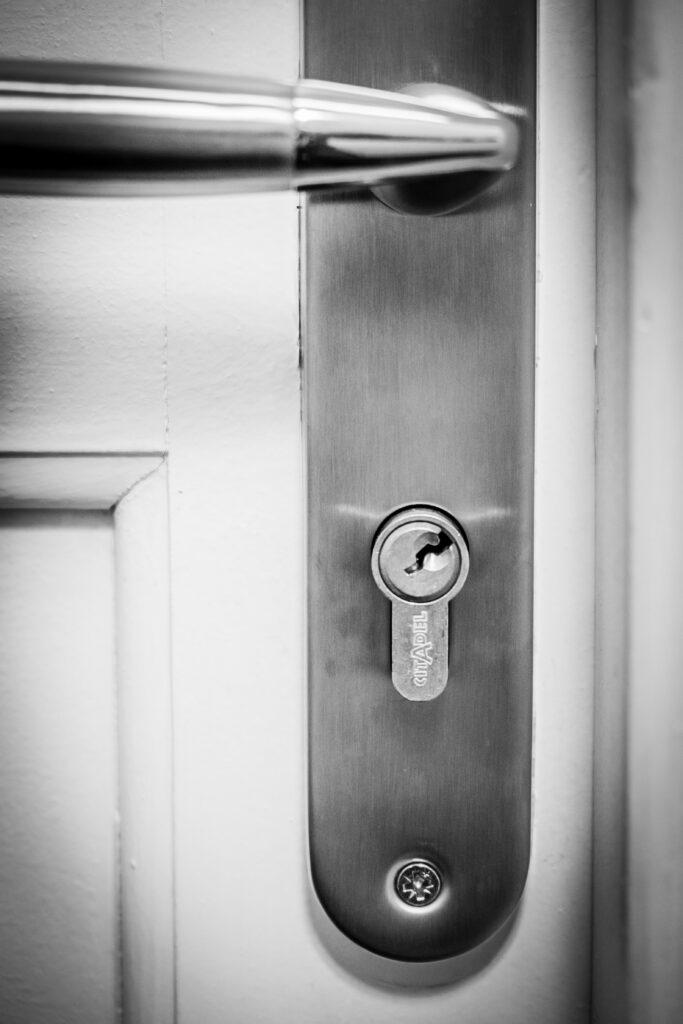
Surreptitious intrusion consists of opening and subsequently closing a locked premises in the absence of a key. The forced entry is effected by means of one or more specific instrument(s), and will not necessarily damage the lock. Only a specialized examination can establish whether such an opening actually occurred and how it was performed. The expert must have an exact knowledge of how the various families of locks operate, be proficient in all possible methods of forced entry — destructive or non-destructive — and understand the physical and mechanical principles involved.
Although this field is relatively little known, surreptitious intrusion — namely the opening and closing of a locked premises without a key — is nonetheless defined by the legislator.
The French Penal Code indeed recalls, in its article 311-5, paragraph 3, concerning aggravated theft, that one of the following circumstances is established: “3° When it is committed in premises … by entering the premises by guile, forced entry or climbing.”
“Breaking and entering” is defined in Article 132-73 of the Penal Code1 as follows: “Breaking and entering consists of the forcing, damaging or destruction of any locking device or any type of enclosure. Also assimilated to forced entry is the use of false keys, unlawfully obtained keys, or any instrument that may be fraudulently employed to operate a locking device without forcing or damaging it.”
Thus, the legislator:
• Acknowledges the possibility that a locked device may be opened without its legitimate key and without damage;
• Considers this modus operandi as an aggravating circumstance;
• Assimilates this modus operandi to “classical” breaking and entering (involving breakage).
Whether in the context of criminal law or in relation to insurance (for which theft “without forcible entry” is often a standard exclusion clause), it is essential to be able to determine the reality of such a burglary.
How can it be determined?
Forcible entry carried out using one or more specific instrument(s) will not necessarily damage the lock. This type of opening—by its nature non-destructive—remains fraudulent and therefore punishable under the law. But how can one know whether such an opening actually took place, and by what means? Only a specialised forensic examination can provide answers to these questions.
Moreover, what is the factual reality of these practices?
A staple of action films, is opening a door without force or damage truly possible? Beyond the simple credit card slipped between the doorjamb and the door (the ‘classic’ unlocking method that anyone who has ever accidentally shut their door with the keys inside has in mind), is this type of opening actually feasible in practice? Is it possible to unlock a door with a five-point locking system—or even an armoured door—without leaving obvious traces?
In this article, we will focus on presenting the ‘invisible’ extent of so-called “subtle” break-ins, and on the expert work that can be carried out to “make locks speak”.
Is a non-destructive, trace-free “subtle” forcible entry possible? And if so, how does it work?
It is commonly accepted that to open a “real” lock (i.e., other than very basic locks) without using the legitimate key, one must either break the key itself or break the element to which the lock is attached, or one of the components that secure the assembly (door, frame and bolt). Yet it is possible to target the lock mechanism itself and thereby operate it “as if the legitimate key were present,” without actually inserting that key.
During a “lock-picking” for example (one of the “soft” techniques among more than a dozen others), the lock can be made to “turn” without the key inside. It then becomes possible to unlock the door. One can even relock it easily without having to pick the lock again. After the opening and subsequent closing of the lock, no trace is visible from the outside and the lock continues to function as before.
Which locks and, more broadly, which security systems are concerned by these “risks”?
The better conceived a system is, the harder it will be to find a way around it. But every system has weaknesses. With the necessary knowledge and sufficient time, it will always be possible to bypass it. From a security standpoint (for readers who may begin to worry about the effective protection of their front door), combining multiple systems and installing them thoughtfully will provide a satisfactory level of security. Nevertheless, each system taken individually remains susceptible to circumvention. Therefore all types of locks are potentially exposed to this risk and may warrant expert analysis when in doubt.
Are these techniques actually used, by whom and in what circumstances?
In the majority of cases — opportunistic burglaries, offences that already produce abundant traces, etc. — the perpetrator(s) will not necessarily possess the skills required to conduct the intrusive part of their crime stealthily. The use of a crowbar allows much faster execution and, provided that the traces left at the scene do not seriously bother them, offenders often make no effort to conceal their tracks.
Nevertheless, covert intrusion methods may be employed in specific cases where the offenders attempt to minimise any sign of their presence (homicides, thefts of sensitive information, disguised thefts, etc.). The appeal of these techniques is real. Numerous online videos present the various lock bypass methods in tutorial form. Likewise, many specialist shops offer the tools necessary to implement these techniques.
It is unfortunate to note that some manufacturers do not restrict sales of such equipment to law enforcement or licensed locksmiths. Moreover, locksmiths themselves seldom use many of these soft techniques because they are costly in terms of training time and equipment and offer little commercial advantage; they often prefer the simple expedient of drilling. While most of these online tutorials are produced by and aimed at enthusiast pickers, they nevertheless put techniques within the reach of all — and therefore also within reach of persons of dubious intent.
Field observations confirm this: an increasing number of offenders specialise in one or another soft-opening technique, according to their preference for a particular offense. During judicial police operations such as searches, investigators may discover items that appear to be intrusion tools. In those circumstances we are regularly asked to determine whether the items are indeed intrusion equipment and whether they can actually function. Precise identification of these tools can thus direct investigators toward a particular modus operandi or toward a specific vehicle make (when the tools are dedicated to opening vehicles), thereby contributing to the establishment of the truth.
What do the used tools look like?
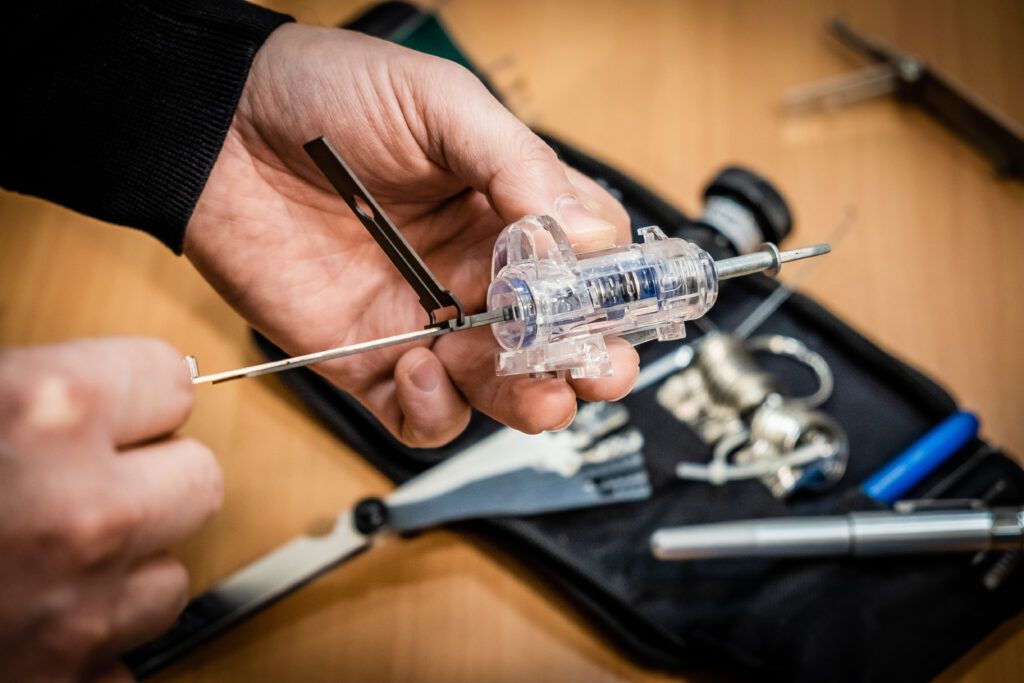
It depends on the targeted lock type. Some tools are general-purpose and cover a broad range of locks. Others are highly specialised: designed for a single type and model of lock, they are devastatingly effective in the hands of someone who knows how to use them.
When conducting an examination of toolmarks to provide real added value to an investigation, it is also important to distinguish between commercial/manufactured tools — which can be obtained more or less easily from specialist suppliers — and homemade tools that some individuals fabricate themselves (which attest to a degree of know-how and can sometimes indicate their maker). One must also mention the existence of ‘decoy’ or ‘dummy’ tools that may have left traces or be found at the scene, yet are incapable of actually opening the lock in question.
Indeed, some persons may wish to create the appearance of an intrusion (which did not in fact occur, or did not occur in the way suggested). They employ all manner of instruments — possibly leaving few traces to support the narrative of a lock being ‘picked’. Once again, the expert’s task is to determine whether the traces are consistent with the use of a tool that could actually have unlocked the device.”
What traces can be visible following an intrusion?
Non-destructive opening techniques leave micro-traces. Those traces are fundamentally different from the impressions normally produced by a legitimate key in its lock, for a variety of reasons. Examples include:
• The shape and thickness of the tools, which differ completely from those of a key and therefore imprint the surfaces they contact in a different manner.
• When a key is inserted, its rotational movement occurs after a straight, tension-free insertion, so this passage does not excessively stress the lock’s various locking elements. This is not the case during lock-picking, where pronounced pressures or ‘micro-forcings’ must be applied to engage the lock’s security components (the elements that secure it).
• Certain areas inside a lock are never in contact with the key and should therefore show no traces other than original machining. During lock-picking, tools may scrape these locations — presumed pristine — leaving significant and diagnostic traces.
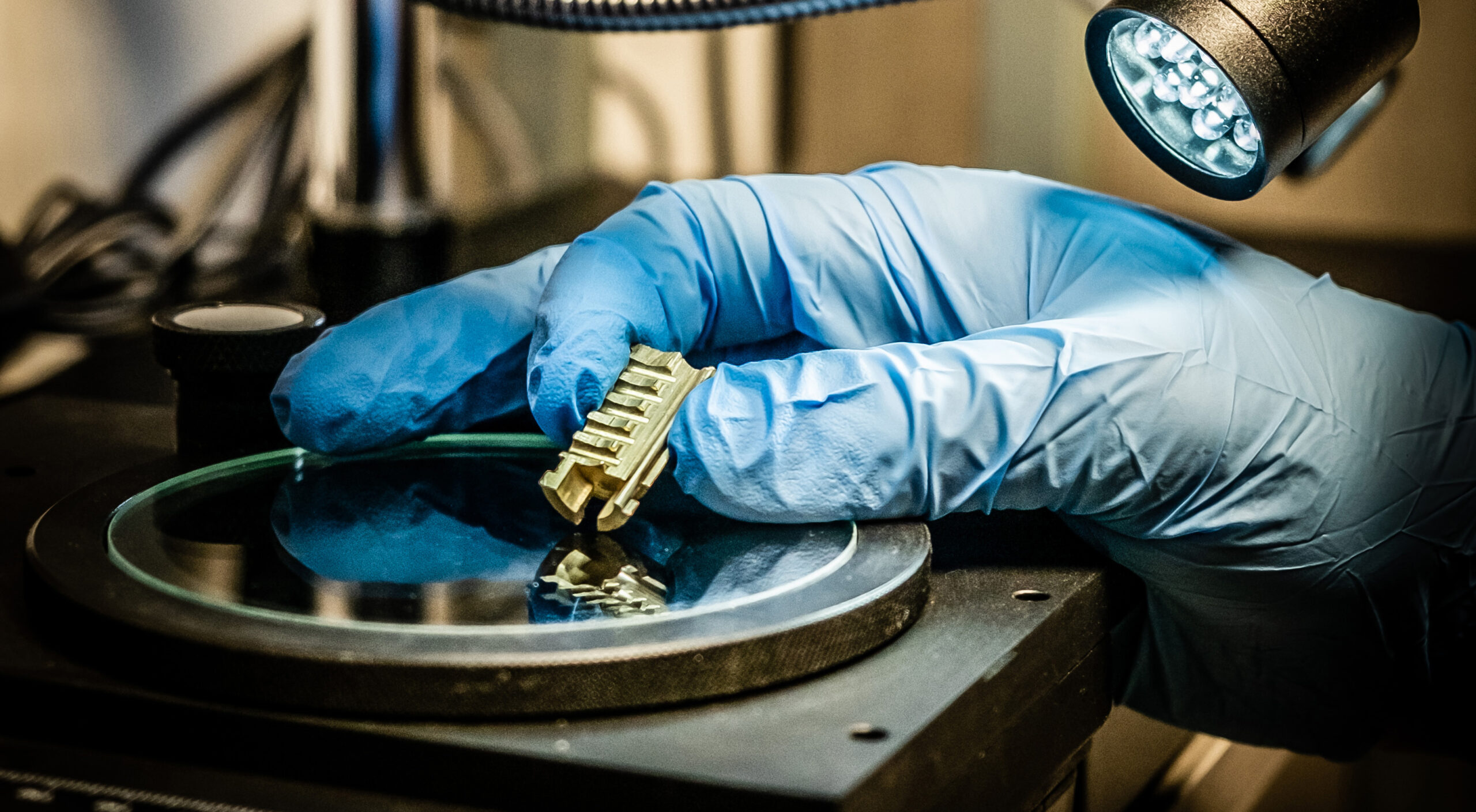
Accordingly, if one knows where and what to look for, it is not only possible to detect that tools have been used, but also to identify with precision the type of attack (including so-called “non-destructive” attacks) the lock has sustained. For example, when using a technique known as ‘bumping’, the tool strikes — sometimes repeatedly — the lock’s pins, producing the characteristic traces illustrated in photo No. 7 below. Traces generated in this way are distinctive of that kind of attack. Demonstrating them can be of great value to the investigation and also helps to profile the “intrusive” methods of the offender.
On what knowledge does the expert rely to identify non-destructive forcible entry?
To examine locks and demonstrate the presence or absence of signs of forced entry, it is essential that the forensic expert have an intimate knowledge of the operating principles of the different families of locks, mastery of the full range of possible forced-entry methods (destructive and non-destructive), and a solid grasp of the physical and mechanical principles at play. The expert must possess in-depth familiarity with existing intrusion tools — including improvised implements — have extensively studied the traces and micro-traces produced by these openings, and know how to disassemble a lock cleanly while absolutely avoiding any contamination that would introduce additional traces. Finally, the expert must be aware of the techniques offenders may use to minimise traces, so as to detect them and determine whether they have been applied.
Searching for traces without knowing what to look for is obviously of little value. In some cases, a lock may display suspicious traces that do not, in fact, result from an intrusion. Such “false positives”2 can be numerous for anyone who lacks real expertise in the discipline.
For these reasons it is imperative, before searching for traces, to identify which technique may have been used and to assess the feasibility of that attack in light of the lock’s environmental context and any associated security elements. Lastly, the expert must be able to put themself in the intruder’s position — that is, be competent to perform these opening methods personally, and even to devise new ones when an innovative modus operandi is suspected. Only an expert capable of thinking like an intruder can truly understand what has been done to a lock. Micro-traces ‘speak’, but the expert must be fluent in the ‘language’ of locks in order to interpret them.
What are the steps of an intrusion expertise ?
A sound forensic examination is difficult to carry out without a proper collection. For this reason it is ideal that the expert collect the lock(s) themselves at the scene. They will take the necessary precautions and fully account for the surrounding environment. When this is not possible, it is preferable that a member of the technical-scientific police (a forensic identification technician or equivalent), who has previously received specific briefing on the subject, perform the collection.
Photo 8: Specialized tool dedicated to vehicle locks for a specific profile (HU66, for Audi, SEAT, Škoda, Volkswagen, etc.) shown inside a transparent demonstration lock
Thus, during collection, the examiner will ensure that nothing is introduced into the lock — or, if removal of the cylinder requires it, that any intervention is carried out following procedures that maximise preservation of potential traces (notably by avoiding contact with the exterior side). They will know which contextual photographs to take so that the expert can situate the lock within its original environment. Likewise, they will ask the proper questions to the lock users. The examination then continues in the laboratory. Preliminary observations are performed and the lock is prepared for analysis. The various components are disassembled, allowing non-destructive observations to be made. The true security level of the lock is assessed and any suspicious traces are sought.
“It is imperative, before searching for traces, to know which technique may have been used and to reconcile the feasibility of an attack with the actual environmental reality of the lock.”
David ELKOUBI
When it is necessary to open the examined item by sectioning and when that is judged the most appropriate course to complete the examination (for example to observe the interior of a cylinder in a location inaccessible without cutting), the sectioning is performed in such a way that it cannot in any way alter the areas of interest to be observed.
Comparisons are made between the examined item and a neutral reference component (often the exterior side of the lock compared with the interior side). Further comparisons are carried out between the traces found and sample toolmarks that may correspond. Finally, a feasibility test is undertaken when material conditions allow. At the end of all these tests, all components are again protected and resealed in order to permit any further observations later if necessary or if those observations need to be disclosed.
How to present a report in an unfamiliar field?
Beyond helping the judge to decide by giving a technical opinion, the expert’s role is to provide magistrates, lawyers and parties with a clear understanding of the technical matter for which the expert was engaged, and to explain the reasoning process that leads him to express such an opinion.
One of the difficulties in this discipline lies in translating sensitive — sometimes even secret — techniques into plain language. These techniques, which an intruder may use, are not readily understood at first glance by a lay reader. For this reason the report details the observations and their implications, explaining how the lock functions under the relevant conditions. A glossary of all technical terms used is appended to the report to render complex terminology simple and comprehensible. Educational clarity is therefore essential so that readers of the report, even without prior knowledge in the field, can grasp the reported observations and their significance.
False positives in intrusion detection
A lock can remain mounted on the same door for decades. Over that period it may undergo many incidents: insertion of a key that was not intended for it, an unsuccessful forcing attempt, deliberate or accidental insertion of foreign objects (for example by children), and so on. In such situations traces may appear on or in the lock. However, those traces do not necessarily indicate an intrusion. The only way to determine whether a trace is truly the consequence of an intrusion is to have a full understanding of the mechanisms of lock-picking and other bypass techniques.
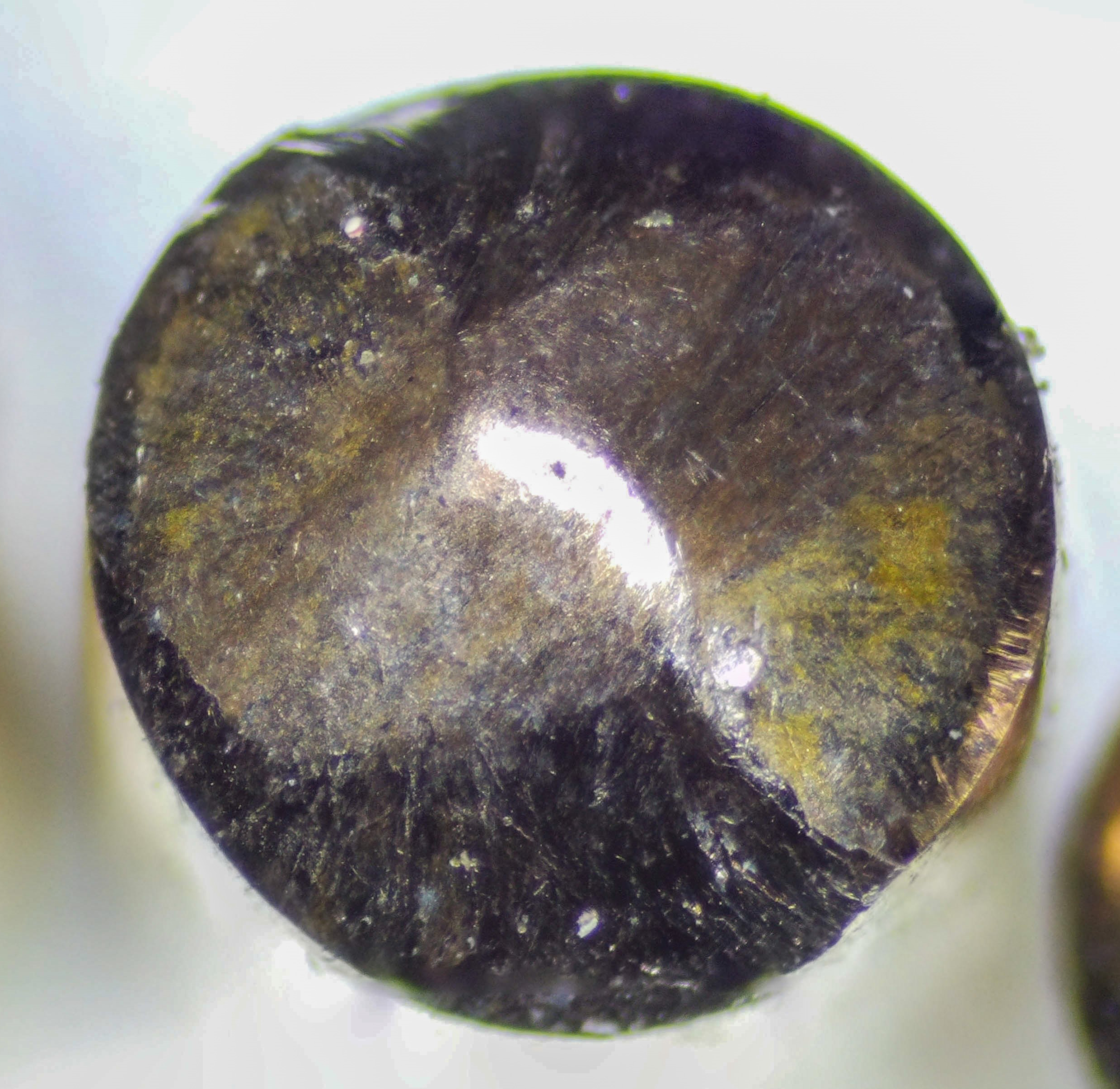
Illustrated beside this text is an example of a pin showing unusual “traces” that are not the result of lock-picking but rather of repeated use of a copied key made from a slightly different blank profile, with a displaced stop. A naïve observation could therefore have led to a false positive (an erroneous conclusion that an intrusion had occurred, when the traces have a different origin).
NOTES :
1 : Concerning the definition of certain circumstances that aggravate, mitigate or exempt penalties. 2 : See the subsection on “false positives for intrusion”.
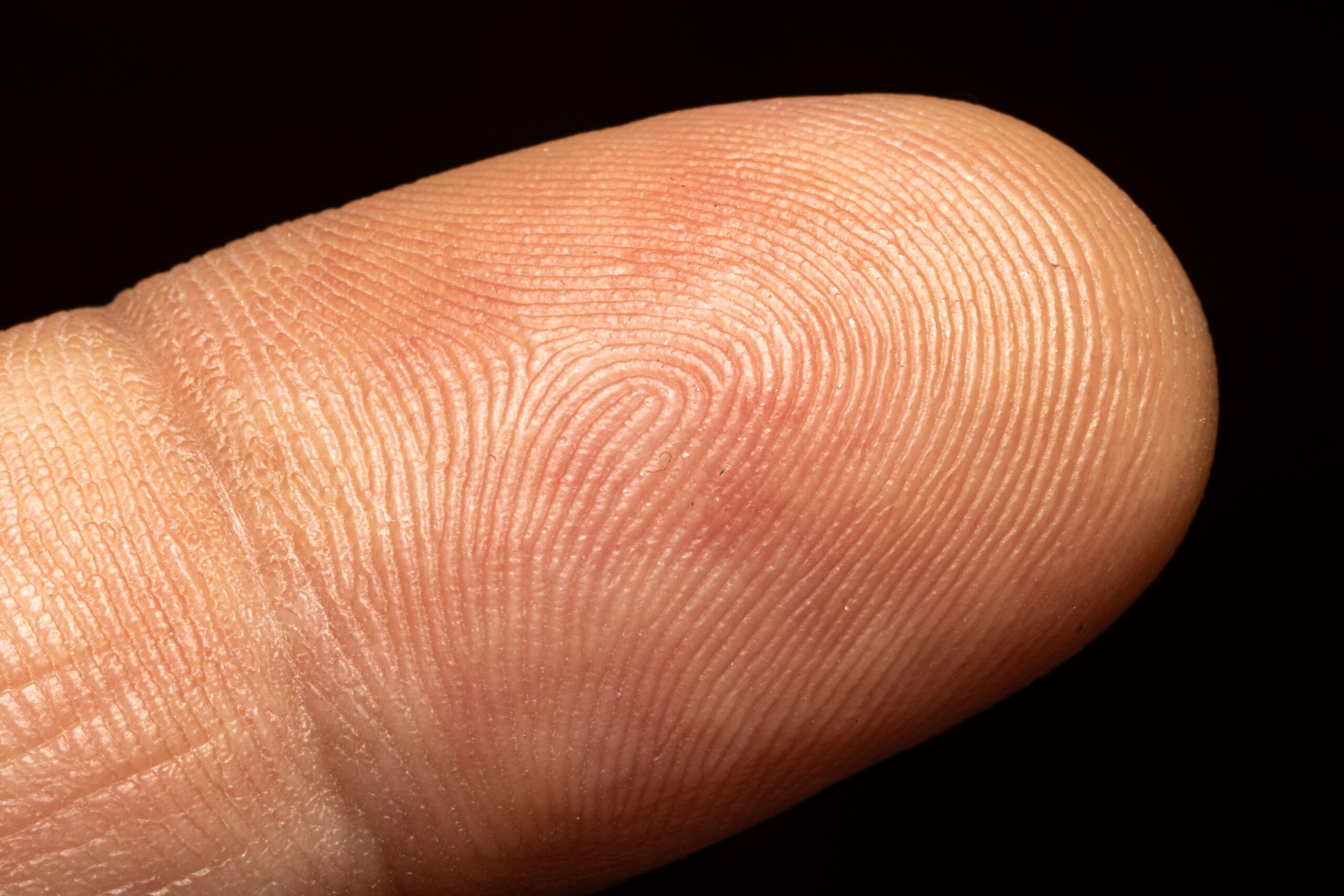
Widely used by law enforcement agencies worldwide for personal identification, fingerprints can also serve as a basis to carry out various screening tests.
Interest in fingerprints has recently been reignited thanks to a new study published on February 1, 2023, by researchers at the Jasmine Breast Unit of Doncaster Royal Infirmary in the United Kingdom. The scientists have developed a digital technique capable of detecting breast cancer with an accuracy of nearly 98%.
Secretions that reveal the disease…
In this case, the focus is not on analyzing fingerprint pattern classes or minutiae—the characteristic points located along the ridge lines that allow for reliable personal identification. Instead, by taking swabs from the fingertips to collect sweat, physicians were able to detect the presence of proteins and peptides identified as biomarkers of potential breast cancer.
This non-invasive, painless technique for patients could make it possible to distinguish between benign, early-stage, or metastatic tumors. If the results are confirmed, it may soon be commercialized in the form of a kit, providing a rapid and reliable diagnostic tool that is significantly less traumatic and less costly than mammography, which remains the current gold standard in breast cancer screening.
…And also detect narcotics!
From medicine to forensic science, there is often only a small step—and in this case, technology has taken it. Sweat sampling from fingerprints is already among the available methods to detect the presence of four classes of narcotics: amphetamines, cannabis, cocaine, and opiates.
Here again, it is the sweat that reveals the presence of these molecules, whether the substance was merely handled or actually ingested. The procedure requires nothing more than pressing the fingertips onto a special piece of paper and then analyzing it using mass spectrometry, which can detect the substance up to 48 hours after contact or ingestion.
Unlike blood tests, which require significant logistics, this analytical method takes only a few minutes and can also be applied to latent fingerprint residues collected at a crime scene. It has also proven effective in the medico-legal context, using post-mortem sweat samples.