
Monthly Archives: December 2022

Empreinte cérébrale une nouvelle méthode d'identification - biométrie et police scientifique Forenseek

Brain fingerprinting: a new identification method?

The Earth is home to eight billion people, and each of them is unique. This individuality has long been harnessed in identification processes—through genetics, fingerprint analysis, and, in the near future, brain fingerprinting.

If the 20th century was marked by technological progress, the 21st will undoubtedly be the century of neuroscience. Thanks to new fMRI (functional Magnetic Resonance Imaging) techniques, it is now possible to capture the “fingerprint” of a brain in less than two minutes—an imprint just as unique as those found at the tips of our fingers, enabling the identification of an individual with an accuracy approaching 100%.

A unique brain fingerprint

Beyond overall brain volume and cortical thickness, the research team at the University of Zurich working on this question has identified anatomical features that are specific to each brain, particularly in the organization of gyri and sulci—patterns that strongly resemble fingerprint ridges. This cerebral “architecture” is shaped not only by genetics but also by the practice of certain activities, life events (such as physical trauma), and the wide range of experiences that a person may undergo throughout their lifetime.

However, it is not so much the image of the brain as its neuronal activity that defines this brain fingerprint. The signals captured by fMRI are synthesized to generate a map of neural networks known as the functional brain connectome. By analyzing this connectome, researchers can create a visual summary in the form of a graph that allows them to track brain activity, identify which regions are engaged (whether sensory or cognitive), and—most importantly for identification purposes—distinguish one individual from another.

Brain fingerprinting in biometrics

Since MRI scans are still time-consuming and expensive procedures, it is unlikely that this identification method will replace fingerprint scanners in the near future.

Nevertheless, government institutions and certain private companies operating in sensitive sectors are showing strong interest in developing biometric technologies based on the identification of brain signals, which could provide advanced security for digital identities.

From smartphones to high-security facilities, systems equipped with fingerprint readers are already in widespread use, but experience has shown that such methods can be falsified. Brain fingerprinting, on the other hand, is essentially tamper-proof, as it relies on a technology driven by a specific and complex algorithm. To implement this form of cerebral biometrics, scientists use an EEG headset (electroencephalography) to record brainwaves generated in response to various sensory stimuli—such as infrequent words, black-and-white or colored images. These responses, which differ from one person to another, constitute an inviolable identity encoded within the brain. Moreover, this profile would be disrupted if the individual were subjected to coercion or violence. Thus, brain fingerprinting could emerge as a biometric technique superior to existing methods, even surpassing retinal scanning, often considered one of the most sophisticated techniques, and opening the door to new applications in forensic science..

Sources :

https://www.futura-sciences.com/tech/actualites/technologie-biometrie-empreintes-cerebrales-nous-identifier-62535/

https://www.sciencesetavenir.fr/sante/cerveau-et-psy/neurosciences-chaque-cerveau-possede-sa-propre-empreinte-digitale_158577

https://ici.radio-canada.ca/nouvelle/1832469/cerveau-empreintes-cerebrales-empreintes-digitales
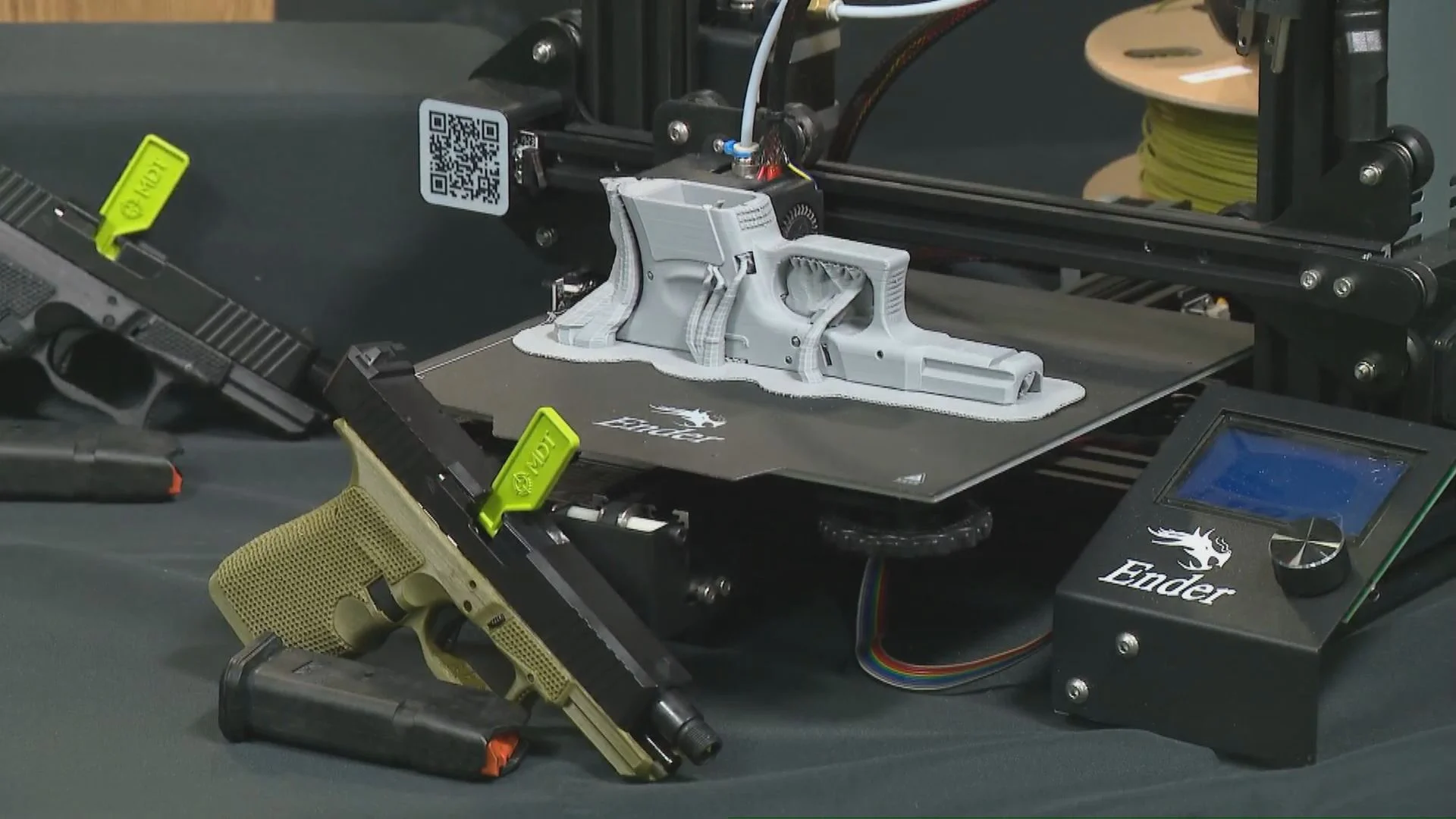
Impression en 3D d'une arme fantôme - Forenseek - Police scientifique

Ghost guns, a genuine threat

All firearms are traceable by police forces around the world thanks to their manufacturing characteristics and their serial numbers. All of them—except for weapons manufactured with a 3D printer, which have appeared in several European countries in recent years.

In 2013, Cody Wilson, a law student at the University of Texas, founded the company Defense Distributed with the aim of developing and distributing 3D-printed firearms. When he published his first free CAD (computer-aided design) file to manufacture a plastic pistol called the Liberator, the response was immediate: no fewer than 100,000 downloads in just two days.

The event did not go unnoticed by the U.S. government, which demanded the file to be removed. That marked the start of a legal battle that culminated in 2018 with the Trump administration’s move effectively legalizing 3D-printed firearms. That decision, blocked in 2019 by a federal judge, was promptly countered by the pro-gun activist network Deterrence Dispensed, which continued to distribute firearm design files invoking the Second Amendment to the U.S. Constitution, which states: “A well regulated Militia, being necessary to the security of a free State, the right of the people to keep and bear Arms, shall not be infringed.” These ghost guns now proliferate in American cities, raising growing concern throughout North America.

UNIDENTIFIABLE AND UNTRACEABLE

Although completely illegal in Europe, these manufacturing files nonetheless circulate on the internet. According to the European police agency EUROPOL, seizures of 3D-printed weapons in the course of investigations on European territory have steadily increased in recent years. Evidence of this includes the dismantling of a workshop dedicated to their production in Spain and the arrest in the United Kingdom of individuals linked to far-right circles who were in possession of components for 3D-printed weapons.

If ghost guns worry authorities on both sides of the Atlantic, it is primarily because they evade any possibility of identification. Every firearm manufactured through an industrial process bears characteristic marks left on its various components (firing pin, ejector, barrel, etc.), as well as on cartridge cases and projectiles, producing a kind of fingerprint unique in the same way as a fingerprint. In most cases, current investigative techniques are also able to recover a serial number even when it has been deliberately obliterated. By contrast, a weapon produced by a 3D printer lacks all of these elements that would allow investigators to trace its origin or to count how many are in circulation.

Another cause for concern is the materials that make up this new generation of weapons. They are generally thermoplastics such as PLA (polylactic acid), derived from renewable resources, or ABS (acrylonitrile-butadiene-styrene), a thermoplastic polymer widely used in household appliances. In both cases, the pistol will not trigger walk-through metal detectors, rendering security measures in public places ineffective—particularly against terrorist attempts. It is all the more undetectable because it can be disassembled piece by piece and then reassembled by hand in a few minutes.

A MAJOR CHALLENGE POSED BY TECHNOLOGY

The only reassuring point in the face of this new threat is the many fragilities of these ghost guns. The manufacturing process with current printers is complex, and the thermoplastics used tend either to deform, crack or break. Confronted with the explosive force of a gunshot, the structure does not hold: tests have shown that the user can usually fire only a single round before one of the weapon’s components fails catastrophically. There are 3D-printed metal gun models, but they are very expensive and thereby lose their “invisibility.”

For experts, however, it is the next development that should be kept in mind. With 3D technologies evolving constantly and very rapidly, one should expect a new generation of printers and higher-performance materials to emerge in the near future, which could then make producing a weapon as simple as child’s play.

Sources :

https://www.ledevoir.com/societe/698724/violence-armee-les-armes-fantomes-un-phenomene-qui-inquiete

https://www.3dnatives.com/armes-imprimees-en-3d-08092020/

https://www.francetvinfo.fr/monde/europe/union-europeenne/de-plus-en-plus-d-armes-imprimees-en-3d-saisies-en-europe-selon-europol_5163001.html

https://www.noovo.info/video/le-ghost-gun-une-nouvelle-menace-pour-les-policiers-au-canada.html