Monthly Archives: October 2025

Towards a revolution in post-mortem forensic imaging

How can an internal lesion go unnoticed during autopsy yet may have potentially caused death? In forensic medicine, understanding internal trauma is essential to reconstructing the sequence of a violent event. Among such injuries, those involving the vertebral artery present a major challenge. Subtle and often concealed by bone structures, they frequently escape traditional examination methods. A recent technological breakthrough in forensic imaging offers a promising approach: combining fluoroscopy and micro-computed tomography (micro-CT) to analyze post-mortem vascular injuries with unprecedented precision.

Key artery, difficult access

The vertebral artery supplies vital regions of the nervous system, including the brainstem, cerebellum, and posterior areas of the brain. Even a minor injury can trigger a stroke, a rapid neurological collapse, or sudden death. Its anatomical pathway, deeply embedded within the cervical spine, makes it particularly difficult to explore. In a forensic context, a lesion affecting this artery represents a critical clue when analyzing a penetrating neck wound, often revealing a potentially lethal intent.

Forensic imaging to observe real-time blood flow

The vertebral artery supplies vital regions of the nervous system, including the brainstem, cerebellum, and posterior areas of the brain. Even a minor injury can trigger a stroke, a rapid neurological collapse, or sudden death. Its anatomical pathway, deeply embedded within the cervical spine, makes it particularly difficult to explore. In a forensic context, a lesion affecting this artery represents a critical clue when analyzing a penetrating neck wound, often revealing a potentially lethal intent.

Micro-CT: diving into the heart of the lesion

To overcome this limitation, researchers have turned to micro-computed tomography (micro-CT), a very high-resolution imaging technique. The sample is rotated during the acquisition of thousands of radiographic images, which are then reconstructed into a digital 3D model. This process reveals otherwise invisible details such as arterial wall tears, thrombi, dissections, or partial ruptures. These reconstructions allow for virtual dissections from multiple angles without altering the body, ensuring a high level of reproducibility, an invaluable feature in forensic investigations.

A standardized method serving both justice and medicine

The protocol developed by Secco and colleagues relies on ex situ imaging, meaning that the examination is performed on an artery extracted from the body. This approach overcomes several obstacles, such as advanced decomposition, previous surgery, complex trauma, or movement artifacts. With the injection of a contrast agent, the vascular network becomes clearly visualized, allowing for precise and stable documentation. These high-quality images serve as robust evidence admissible in court and represent a valuable resource for medical teams involved in planning neurosurgical or trauma-related procedures.

An educational and scientific tool

Beyond their diagnostic value, 3D reconstructions and fluoroscopic videos serve as outstanding educational tools. They allow for a strikingly realistic visualization of injury mechanisms and a deeper understanding of the biomechanics of penetrating trauma. This refined comprehension of the forces at play helps not only researchers characterize vascular lesions, but also engineers design more effective protective equipment and forensic experts accurately reconstruct the circumstances surrounding a violent act.

Towards a new standard in forensic medicine

Born from close collaboration between radiologists, pathologists, engineers, and chemists, this imaging protocol represents a major step forward in forensic practice. The growing accessibility of micro-CT equipment suggests its forthcoming integration into routine autopsies. With the continuous improvement of imaging technologies in terms of resolution, speed, and multi-contrast capacity, the prospect of non-invasive post-mortem vascular examinations is becoming increasingly realistic. In the long term, this method could be extended to other arterial regions (carotid, subclavian, intracranial), thereby deepening our overall understanding of vascular trauma.

Conclusion

At the crossroads of technology and forensic science, this approach combines precision, rigor, and innovation. By providing a three-dimensional and reproducible reading of internal injuries, it transforms the way stab wounds involving the vertebral artery are analyzed. This is a major advancement, serving both judicial truth and scientific knowledge, and it paves the way for a new generation of autopsies that are finer, more reliable, and better documented.

References  :

Bioengineer.org. (2024). Detecting Vertebral Artery Stab Wounds with Imaging. Read here.

Secco, L., Franchetti, G., Viel, G. et al. Ex-situ identification of vertebral artery injuries from stab wounds through contrast-enhanced fluoroscopy and micro-CT. Int J Legal Med (2025). Read here.

Medscape. (2024). Vertebral Artery Anatomy. Read here.

Post-traumatic symptoms in individuals who were victims of childhood sexual abuse

The clinical and judicial assessment of children who are victims of sexual abuse requires an in-depth understanding of child development and of the manifestations of post-traumatic symptoms that are typical of childhood and adolescence. Recognizing the specific symptom patterns in children makes it possible to distinguish traumatic manifestations from normal developmental variations, within an approach that must necessarily respect the child’s world.

Respecting and building upon the child’s world

Working with children involves using mediating tools that correspond to their developmental world, employing language and tone appropriate to their age, and exploring their personal interests. Beyond the therapeutic alliance that this fosters, a child’s interests also serve as indicators of their developmental level, environment, and daily organization. These are valuable cues for forensic evaluation.

For instance, consider an 8-year-old child in second grade who, when simply asked about his favorite activities, mentions playing a Paddington game on a tablet. When gently questioned about the tablet and the game, through prompts such as “What do you like about this game?” or “Can you tell me more about this tablet?”, the child explains that the tablet belongs to his father, that he does not have one of his own, and that he is allowed to play on it on Wednesdays and weekends for 30 minutes in the family living room. He says he likes the little bear for his adventures, and is then asked to describe one of his favorite moments.

Respecting the child’s world means striving to avoid the risk of retraumatization during the forensic examination.

The child’s responses allow the evaluator to assess several aspects: an interest and activity consistent with their developmental age, a family framework appropriate for their age regarding screen use, and the child’s ability to construct a narrative (use of pronouns and tenses, spatial and chronological structuring, distinction between imagination and reality, etc.). The interpretation will naturally differ if the child plays a game such as Call of Duty, a war-themed game, rated 16+ or 18+ depending on the version, if the 8-year-old has a screen in their bedroom, or if the subject is instead a 15-year-old adolescent.

Finally, and in my view, most importantly, respecting the child’s world means striving to prevent the risk of retraumatization during the forensic examination. Creating an environment that signals to children they are welcome is essential: children’s books in the waiting area, toys, comfortable seating, and the freedom to move around. Advising caregivers to bring a comfort object or soft toy (doudou) is also important. Returning to the question of post-traumatic symptomatology in children, this issue takes on a particular resonance in light of recent cases such as that of Joël Le Scouarnec, in which 299 identified victims exhibited significant post-traumatic symptoms despite an apparent absence of conscious memories of the assaults committed under anesthesia.

The theoretical framework of sexual psychotrauma

The psyche refers to the entirety of conscious and unconscious mental phenomena: cognitive processes (thought, memory, perception), affective processes (emotions, feelings), psychological defense mechanisms, fantasy and imaginative activity, and personality structures. A traumatic event represents a violent intrusion into the psyche, exceeding the mental apparatus’s capacity for processing and integration what is referred to as traumatic breach (effraction traumatique).

A child who has been sexually abused often remains in denial for a long time

Traumatic breach in a child who has been sexually assaulted presents particular characteristics. Louis Crocq (1999) defines psychotrauma as “a phenomenon involving a breach of the psyche and the overwhelming of its defenses by violent stimuli linked to the occurrence of an event that is aggressive or threatening to the life or integrity (physical or psychological) of an individual who is exposed to it as a victim, witness, or actor.” In cases of sexual assault, this breach takes on a dimension that is beyond the child’s psychological comprehension. As Tardy (2015) points out, “A child who has been abused often remains in denial for a long time, a defense mechanism aimed at avoiding the realization that the adults supposed to protect them were, in fact, the aggressors, which would be too distressing to acknowledge.”

The repetition syndrome, as described by Crocq (2004), is defined as “a set of clinical manifestations through which the traumatized patient involuntarily and repeatedly relives their traumatic experience with great intensity.” Thus, in children and adolescents, as in adults, numerous symptoms related to repetition or avoidance of repetition can be observed.

Age-specific symptoms: a developmental approach

Traumatic manifestations in younger children:

They are characterized by poorly integrated intrusive recollections, consisting mainly of intense sensations and emotions, as described by Eth and Pynoos (1985) and by Pynoos, Steinberg et al. (1995). Beyond ordinary childhood play, specific play behaviors linked to the traumatic event may emerge. These post-traumatic play patterns represent a major clinical indicator. Fletcher (1996) describes them as “repetitive, involving a central element connected, or sometimes not connected, to the event, less elaborate and imaginative than typical play, generally emotionally charged (anxiety), rigid, and joyless.” Such play loses its normal creative and exploratory function, becoming compulsive and stereotyped.

Neurovegetative hyperarousal and avoidance are common post-traumatic symptoms. In children, they manifest as anxious hypervigilance, exaggerated startle responses, and sleep disturbances with frequent awakenings. Avoidance may take the form of social withdrawal, emotional numbing, and developmental regression affecting toilet training, sleep, or the reemergence of early childhood fears. In his longitudinal study of 166 sexually abused children, Putnam (2003) found that 40% developed hyperactivity symptoms within six months following disclosure, compared to 8% in the general population. The author interprets this hyperactivity as an adaptive flight response to intrusive post-traumatic stimuli.

Some children develop overly smooth, inconspicuous behaviors that draw no attention at all.

Post-traumatic manifestations in children often display little-known specificities that make their identification particularly complex. Unlike adults, children frequently present with nonspecific symptoms according to developmental research, especially younger children (under six years old).

From the earliest age, disturbances in body awareness and bodily experience constitute a key clinical marker: restriction in clothing choices or adoption of sexualized clothing, extreme washing behaviors, difficulties with nudity, poor bodily investment, a devalued image of their body or of certain body parts, disturbances in tactile relationships, and avoidance of affectionate gestures. These bodily manifestations often go unrecognized because they may appear trivial or be attributed to other causes. In contrast to the agitation sometimes observed, some children develop overly smooth, inconspicuous behaviors that draw no attention at all. This inhibited presentation, characterized by excessive compliance and extreme conformity, paradoxically constitutes a warning sign. Research emphasizes the importance of “keeping in mind that some of these behaviors are common in this age group. Thus, symptoms of neurovegetative hyperarousal are expressed more as an intensification of behaviors already present in the child, sometimes difficult for significant others to notice” (Eth & Pynoos, 1985; Pappagallo, Silva & Rojas, 2004).

Older children (6 to 12 years old):

In addition to the previously described symptoms, children in this age group may present somatic complaints (headaches, abdominal pain, etc.) which, due to their nonspecific nature, are not always associated with sexual trauma. Nevertheless, these somatic manifestations are important clinical indicators within a comprehensive assessment.

In school-aged children, intrusive memories become more structured but may include protective cognitive distortions that minimize the severity of the event. Post-traumatic play also evolves: it becomes “more elaborate and sophisticated, involving transformation of certain aspects of the event, the introduction of symbolic dangers (monsters), and the inclusion of other people (peers)” (Fletcher, 1996). These transformations reflect an attempt at more mature psychological processing. School functioning often becomes significantly affected, with attention difficulties, declining academic performance, anxiety-related school refusal, as well as diminished self-esteem and reduced trust in caregivers. Frequent somatic symptoms may also lead to school absenteeism.

Adolescence :

Drawings and post-traumatic play become rare, replaced by other modes of expressing distress. Manifestations resemble those observed in adults (Yule, 2001; Rojas & Lee, 2004), with recurrent memories, flashbacks, and pronounced emotional numbing, that is, a marked reduction in the intensity and range of emotional expression. Emotional numbing manifests through diminished or fixed facial expressions, a monotone voice, dull or inexpressive eyes, inappropriate or absent emotional responses, and a reduced capacity to feel joy, sadness, or anger. It may lead to difficulties forming emotional bonds, impoverished interpersonal relationships, and an impression of “coldness” perceived by others. Addictive behaviors may emerge, involving either substances (alcohol, drugs, toxic products) or activities (video games, pornography, sexual behaviors, gambling), along with risk-taking behaviors (speeding, dangerous stunts, delinquent acts).

The assessment must distinguish between normal sexual exploration and pathological manifestations.

Specific symptoms of sexual trauma

Disturbances in body awareness and bodily experience are characteristic and represent a specific marker of physical and sexual trauma. Overall, the sexualization of language and behaviors is a strong indicator, particularly when the change appears suddenly.

Problematic Sexual Behaviors (PSB) represent a specific manifestation that is especially important to identify. According to the ATSA (Association for the Treatment of Sexual Abusers), PSB are defined as “sexual behaviors displayed by a child that are considered inappropriate for their age or level of development” and that may be “harmful to the child themselves or to other children involved.”

PSB are defined in children up to age 12, and their assessment requires a solid understanding of child and adolescent sexual development, as well as the use of age-appropriate language. This definition follows a developmental approach in which assessment must distinguish normal sexual exploration from pathological manifestations. According to Chaffin et al. (2006), sexual behaviors are considered problematic when they meet one or more of the following six criteria: they occur with “high frequency or intensity,” “interfere with the child’s social or cognitive development,” “involve force, coercion, or intimidation,” are “associated with physical injury or emotional distress,” “occur between children of different developmental stages,” and “persist despite adult intervention.” PSB may include sexual touching of other children, excessive masturbation, sexual knowledge that is inappropriate for the child’s developmental stage, or hypersexualized behaviors.

Symptoms in adulthood:

Longitudinal studies demonstrate the persistence of symptoms into adulthood. A British study of 2,232 18-year-old participants revealed an increased risk of psychiatric disorders: 29.2% presented with major depression, 22.9% with conduct disorders, 15.9% with alcohol dependence, 8.3% with self-harming behaviors, and 6.6% with suicide attempts.

The impact on intimate and marital life is particularly well documented. According to Gérard (2014), nearly 60% of adults who were sexually abused in childhood experience relationship isolation, and 20% have never been able to form a long-term partnership. Relational difficulties are characterized by a paradoxical oscillation between excessive mistrust and dependence, polymorphic sexual disturbances (“hypersexuality or lack of libido, absence of pleasure, pain, risky sexual behaviors”), and the search for a “repairing” partner that often leads to intense frustration. Among women, specific menstrual disturbances are frequently reported from puberty onward: irregularities, pain, amenorrhea, and feelings of disgust.

In forensic evaluations of adults who were sexually abused as children, many of the same symptoms observed in childhood may reappear: persistent masturbatory behaviors originating around the time of the abuse or its disclosure, avoidant somatizations, and attention difficulties. Collecting these clinical indicators can help establish coherence with the events described in the context of psychological expertise. Moreover, for the victim, such analysis can provide meaning to behaviors that were previously misunderstood or socially disapproved of.

It is not necessary to remember in order to suffer from post-traumatic symptoms

The Scouarnec case: symptoms without memory

The Scouarnec case illustrates perfectly the issue of post-traumatic symptoms in the absence of conscious memory. The 299 identified victims, mostly minors who were assaulted under anesthesia, exhibited symptomatic manifestations even before the facts were revealed by investigators. Amélie Lévêque testified: “I actually had so many aftereffects from that operation that were there, but no one could explain them.” These sequelae included medical phobias, eating disorders, and “the diffuse feeling that something abnormal had happened.” Expert witnesses at the trial confirmed that “it is not necessary to remember in order to suffer from post-traumatic symptoms.

Jean-Marc Ben Kemoun, child psychiatrist and forensic doctor, explains this phenomenon as the “memory of the body”: “The body speaks, and the less we are consciously aware of a painful or stressful event, the stronger its impact on the body.” Even in an altered state of consciousness, the traumatic impact persists, generating long-lasting symptoms in the absence of explicit memory.

Clinical implications and perspectives

This clinical reality underscores the importance of a multidimensional assessment that respects developmental particularities. Forensic evaluation must include the observation of play and interests according to age, assessment of social and academic adjustment, and evaluation of the individual’s ability to project themselves positively into the future. The Scouarnec case demonstrates that the absence of conscious memories in no way excludes the existence of trauma and its lasting consequences. This understanding is essential for a symptom-based clinical assessment, particularly in young children or in individuals who experienced sexual trauma before the age of six.

Bibliographie :

Crocq, L. (2004). Traumatismes psychiques : Prise en charge psychologique des victimes. Paris : Masson.

Tardy, M.-N. (2015). Chapitre 8. Vécu de l’enfant abusé sexuellement. Dans M.-N. Tardy (dir.), La maltraitance envers les enfants. Les protéger des méchants (pp. 123-150). Paris : Odile Jacob.

Drell, M. J., Siegel, C. H., Gaensbauer, T. J. (1993). Post-traumatic stress disorder. Dans C. H. Zeanah (dir.), Handbook of infant mental health (pp. 291-304). New York : Guilford Press.

Fletcher, K. E. (1996). Childhood posttraumatic stress disorder. Dans E. J. Mash & R. A. Barkley (dir.), Child psychopathology (pp. 242-276). New York : Guilford Press.

Frank W. Putnam, Ten-Year Research Update Review: Child Sexual Abuse, Journal of the American Academy of Child & Adolescent Psychiatry, Volume 42, Issue 3, 2003, Pages 269-278,

Pynoos, R. S., Steinberg, A. M., Wraith, R. (1995). A developmental model of childhood traumatic stress. Dans D. Cicchetti & D. J. Cohen (dir.), Developmental psychopathology (Vol. 2, pp. 72-95). New York : Wiley.

Scheeringa, M. S., Zeanah, C. H. (2003). Symptom expression and trauma variables in children under 48 months of age. Infant Mental Health Journal, 24(2), 95-105.

Yule, W. (2001). Post-traumatic stress disorder in the general population and in children. Journal of Clinical Psychiatry, 62(17), 23-28.

Gérard, C. (2014). Conséquences d’un abus sexuel vécu dans l’enfance sur la vie conjugale des victimes à l’âge adulte. Carnet de notes sur les maltraitances infantiles, 3, 42-48. DOI : 10.3917/cnmi.132.0042

Chaffin, M., Letourneau, E., Silovsky, J. F. (2002). Adults, adolescents, and children who sexually abuse children: A developmental perspective. Dans J. E. B. Myers, L. Berliner, J. Briere, C. T. Hendrix, C. Jenny, & T. A. Reid (dir.), The APEAC handbook on child maltreatment (2e éd., pp. 205-232). Thousand Oaks, CA : Sage.

Chaffin, M., Berliner, L., Block, R., Johnson, T. C., Friedrich, W. N., Louis, D. G., … & Silovsky, J. F. (2006). Report of the ATSA task force on children with sexual behavior problems. Child Maltreatment, 11(2), 199-218.

Gury, M.-A. (2021). Pratique de l’expertise psychologique avec des enfants dans le cadre judiciaire pénal. Psychologues et Psychologies, 273, 24-26.

France Info (6 mars 2025). Procès de Joël Le Scouarnec : une affaire “entrée par effraction” dans la vie de nombreuses victimes, sans souvenirs d’actes subis sous anesthésie.

France 3 Bretagne (14 avril 2025). Procès le Scouarnec : “même sans souvenirs, on peut souffrir de troubles post-traumatiques”. consultable ici.

Pôle fédératif de recherche et de formation en santé publique Bourgogne Franche-Comté (2025). Aide au diagnostic et au repérage ajusté du comportement sexuel problématique chez l’enfant. Projet de recherche AIDAO-CSP.
Reconstruction of torn documents

When a document has been torn or shredded, the investigator is faced with a puzzle that has lost its box, its reference image, and sometimes even a portion of its pieces. Yet, the information contained within those fragments can alter the course of a case: a single figure in a contract, a name in a table, or a handwritten note in the margin. The question is therefore not merely “can it be reconstructed?”, but rather “can it be done reliably, traceably, and fast enough to be of use to the investigation?”

Why reconstruction is challenging

In forensic practice, fragments are rarely clean or uniform. They vary in shape, size, paper texture, ink density, and orientation. When several documents have been destroyed together, the fragments intermingle and create visual ambiguities: two edges may appear to fit when they do not, two different fonts may look similar, and uniform areas, blank backgrounds or low-detail photographs, provide almost no clues. So-called edge-matching approaches, which seek continuities along borders and patterns, work fairly well for small sets. But as the number of fragments grows, the number of possible combinations increases exponentially, and these methods struggle to discriminate between competing hypotheses.

The idea: harnessing randomness to explore better

Stochastic optimization offers an alternative way to approach the problem. Rather than attempting to reach the perfect configuration immediately, the algorithm generates plausible assemblies, evaluates them, and occasionally accepts “imperfect” choices in order to continue exploring the solution space. This probabilistic strategy continuously alternates between two complementary phases: exploration, which searches new pathways to avoid dead ends, and exploitation, which consolidates promising insights already discovered. In practice, each proposed assembly is assigned a score based on visual continuity (alignment of letters, extension of strokes, texture and color matching). If coherence improves, the hypothesis is adopted; if it deteriorates, it may still be tolerated for a while to test whether it leads to a better configuration later on. This flexible logic distinguishes the method from more rigid approaches such as simulated annealing or certain genetic algorithms. It adapts better to the real variability of documents and fragment mixtures, and it leaves room for light operator interaction when needed.

What the experiments show

The authors report large-scale tests conducted on more than a thousand heterogeneous torn documents (office printouts, handwritten pages, images, and mixed-content sheets). The results converge toward an observation intuitive to any expert: the richer a document is in content (dense text, grids, or patterns), the faster and more accurate the reconstruction process becomes. Conversely, uniform areas require more iterations because they provide few visual anchor points. In the most challenging cases, occasional operator input, such as confirming a match or indicating the probable orientation of a fragment, is sufficient to guide the algorithm without compromising overall reproducibility.

Validation through a benchmark challenge

To evaluate the method under conditions close to real-world scenarios, the researchers tested it on fragment datasets inspired by the DARPA Shredder Challenge, a well-known benchmark in which participants attempt to reconstruct documents shredded into very narrow strips or confetti-like pieces. The method successfully reconstructed coherent and readable pages where other techniques either failed or stalled. This is more than an academic result: it demonstrates that the algorithm performs robustly when faced with investigative constraints, including numerous, intermingled, and occasionally damaged fragments resulting from handling or scanning.

Relevance to forensic practice

Beyond raw performance, the value of such a method lies in its integration into a demonstrable forensic workflow. The initial reconstruction phase, typically the most time-consuming, can be largely automated, freeing analysts to focus on content examination. More importantly, the approach lends itself to precise traceability: a log of tested hypotheses, retained parameters, acceptance thresholds, and intermediate captures. These records help document the chain of custody, justify technical choices before a magistrate, and, when necessary, reproduce the procedure in full transparency.

In laboratory settings, integration is facilitated by adopting rigorous acquisition practices such as high-resolution scanning, neutral backgrounds, color calibration, and systematic archiving of source files. A preliminary physical sorting of fragments, by paper weight, hue, or the presence of images, also enhances robustness by reducing ambiguities at the input stage.

Limitations and avenues for improvement

As with any optimization method, performance depends heavily on proper parameter tuning. Thresholds that are too strict will hinder exploration, while overly permissive criteria make it erratic. Highly mixed batches, comprising visually similar documents with identical layouts or fonts, remain difficult and may require occasional human intervention to prevent mismatches. Micro-fragments produced by high-grade shredders represent another major challenge: the smaller the visible surface, the fewer cues the algorithm can exploit. Future progress is expected in improving robustness against scanning artifacts, automating pre-sorting steps, and, more broadly, establishing standardized performance metrics (such as edge-matching accuracy, page completeness, and computation time) to facilitate fair comparison between methods.

Conclusion

Reconstructing torn documents is no longer solely a matter of expert patience and intuition. Stochastic optimization provides an exploration engine capable of handling large volumes, managing uncertainty, and producing usable assemblies. By combining automation, traceability, and expert supervision when needed, this approach transforms an “impossible puzzle” into a systematic procedure, serving the purposes of material evidence, intelligence gathering, and the preservation of damaged archives.

References :

Textile fibers as tools to understand criminal activity

The recurring question in many criminal investigations is undoubtedly the following: what really happened? This seemingly simple question is often difficult to answer, even though both the tactical and scientific aspects of modern criminal investigations benefit from cutting-edge technologies. Added to this complexity are cases in which the victim is deceased, the suspect provides incomplete statements, or several suspects or witnesses offer contradictory versions of events. Investigators then have no choice but to turn to traces and physical evidence that may shed light on the modus operandi of the crime.

Activity as a key concept

The unfolding of a criminal act often involves an intense level of activity that sharply contrasts with the routine activities of daily life. Taking, for instance, a case of manual strangulation, the criminal act is likely to involve an initial struggle, followed by strangulation leading to death, and possibly the movement of the body in an attempt to conceal the crime. Such activity inevitably generates multiple points of contact between victim and perpetrator, resulting in the transfer of traces, as described by Edmond Locard in his Treatise on Criminalistics.

Verifying the presence or absence of traces is the first essential step in any criminal investigation. This preliminary search can already provide valuable clues to suggest a criminal act or the suspect’s presence at the scene. However, not all traces are immediately visible—examples include touch DNA or microtraces. Relevant sampling can later yield additional information through laboratory analyses. It should nevertheless be remembered that the absence of traces does not necessarily indicate an absence of contact, and conversely, the presence of traces may sometimes be legitimate.

Attempting to understand the modus operandi of a crime requires examining traces not merely in terms of their presence or absence, but rather in relation to their quantity and/or distribution. In the case of textile fibers, forensic literature has shown that intense and/or repeated contact—as occurs during a criminal act—results in the transfer of a greater number of fibers than ordinary, legitimate contact in daily life. As for the location of these fibers, it is often linked to the area where the most intense activity occurred, such as the neck region in cases of manual strangulation. The level of activity during the criminal event can therefore be inferred from both the quantity and distribution of transferred textile fibers.

Expertise de fibres en police scientifique - Forenseek

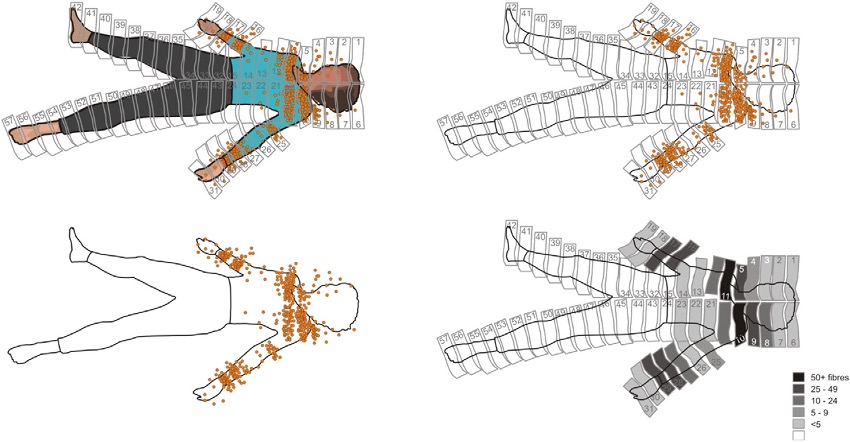
Different ways of representing the distribution of fiber traces on the victim’s body, used to illustrate the fiber examination report and facilitate understanding of contact areas. The colored image (top left) represents the actual crime scene photograph. The three other images show a schematic version of the body derived from that photograph. The position and density of the fiber traces can be represented using small colored symbols (here, orange dots) or by coloring the adhesive tape areas according to a graded color scale. © 2015 The Chartered Society of Forensic Sciences. Published by Elsevier Ireland Ltd. All rights reserved

The absence of traces does not always indicate the absence of contact, and the presence of traces may also have a legitimate origin.

Microscopic textile fiber traces

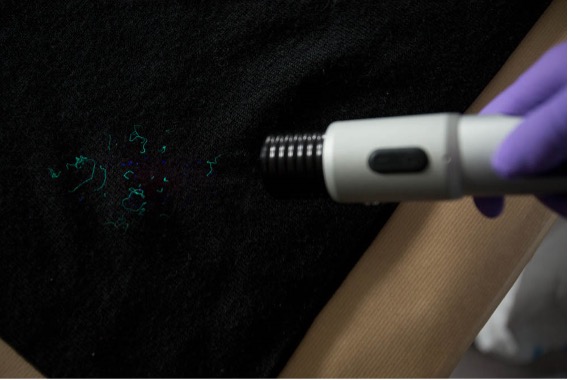
Textile fibers—microscopic entities and the fundamental components of textile materials—are generally present as protruding elements on the surface of clothing, from which they can be transferred through contact. The exchange of microscopic fiber traces between victim and perpetrator typically occurs through friction between their garments, particularly in areas of intense or repeated contact. It should be noted that fibers can also be transferred onto other substrates such as skin or hair. The exchanged fiber traces thus serve as microscopic evidence that contact has taken place—they simply await to be uncovered!

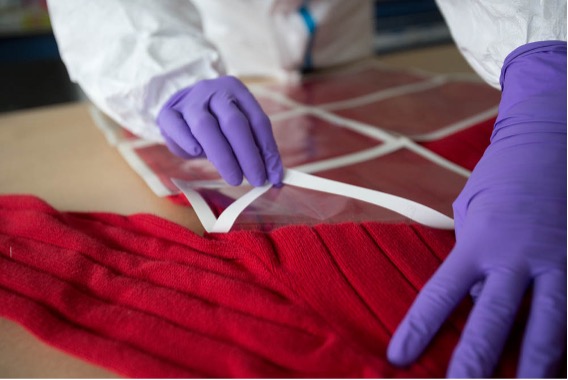
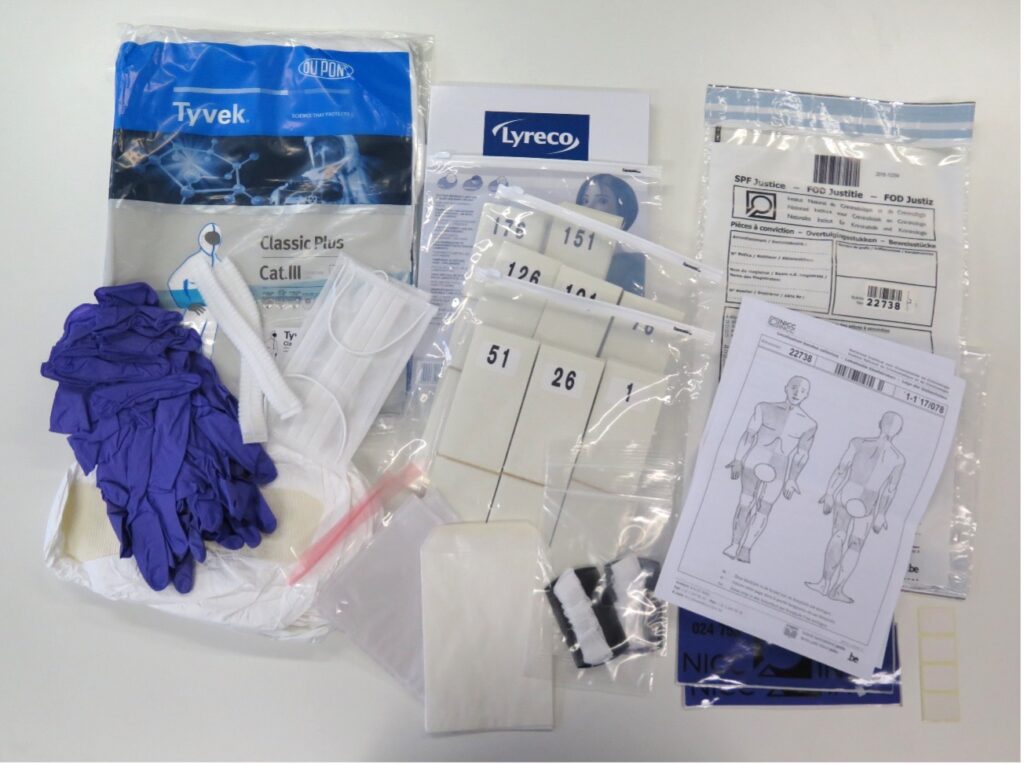
Microscopic textile fiber traces are usually invisible to the naked eye and therefore require systematic sampling. The most widely used collection method in Europe is the application of adhesive tapes over the entire surface likely to bear traces—a technique known as taping or tape-lifting. The manner in which adhesive tapes are applied depends on the working conditions and the objective of the collection. A “zonal” application (each adhesive tape is dabbed multiple times to cover an area larger than its own dimensions) may be considered sufficient when the objective is to preserve traces quickly, or when the garment has already been heavily handled—for instance, by emergency personnel. Conversely, if precise localization of traces is required, the ideal method is the “1:1” technique (each adhesive tape is applied once only to cover an area equivalent to its own size, with adjacent tapes placed edge to edge to cover a wider surface). The more precise the sampling technique, the clearer both the localization and quantity of fiber traces will appear on the trace mapping diagram produced after laboratory processing. It is worth noting that the “1:1” technique is recommended when blood or touch DNA traces are also to be analyzed on the clothing, as the “zonal” technique may disperse or dilute biological material.

The search for microscopic fiber traces on adhesive tapes is still carried out entirely manually. In the absence of automated equipment, the laboratory analyst examines each adhesive strip under a stereomicroscope, looking for relevant traces. For instance, if the suspect was wearing a red cotton T-shirt, the analyst examining the victim’s samples will focus attention on red cotton fibers of a similar hue to that of the suspect’s garment. The detected traces are usually marked directly on the adhesive tape with an indelible marker, allowing for easy localization and counting.

The next step involves analyzing part or all of the recovered traces, after carefully extracting them from the adhesive tape and mounting them individually on properly labeled glass slides to ensure full traceability. According to forensic literature, optimal discrimination is achieved by combining high-magnification microscopic examination (typically 400×) with objective color measurement obtained through microspectrophotometric absorbance analysis. The chemical composition of synthetic fibers may also be verified, when necessary, using infrared spectroscopy. Fiber traces exhibiting the same properties as those of the comparison garment are described as matching or indistinguishable from an analytical standpoint.

In cases where there is no prior information regarding the clothing worn by the perpetrator, the same type of analytical work can still be conducted, but in a more investigative approach.

Knowing both the quantity and location of the so-called corresponding traces makes it possible to establish a trace map on the victim’s body—provided that sampling covered the entire body (clothing, skin, and hair) of the deceased. A simpler trace diagram can also be produced when at least the victim’s clothing has been promptly collected following seizure.

In the absence of information regarding the clothing worn by the perpetrator, a similar analytical approach can still be undertaken, albeit in a more investigative manner. In this case, the laboratory analyst must identify, on the adhesive tapes, fibers of similar appearance (shape and color) that recur consistently and are foreign to the victim’s clothing. The marked traces are then analyzed to determine whether they indeed form a group of fibers indistinguishable from one another from an analytical standpoint. If confirmed, the properties of this fiber group—particularly color and chemical composition—may be communicated to investigators to help target suspect garments during future searches. Such garments can subsequently be used as comparison material for the fiber traces, or analyzed for other types of forensic evidence such as blood or touch DNA.

The search for microscopic textile fibers is presented here primarily from the perspective of criminal contact between a victim and a murderer, involving the systematic collection of microtraces from the victim’s body at the crime scene. This procedure follows a standardized forensic protocol, notably applied in Belgium. However, the sampling and examination of fiber microtraces can, of course, be performed on other substrates besides the body or clothing of the victim—such as a suspect’s garments, vehicle seats or trunk, a knife, or any other object used as a weapon.

The forensic examination of textile fibers remains a largely overlooked discipline, the value of which is often underestimated.

Expertise de fibres en police scientifique - Forenseek

Figure 2: Microtrace collection technique using adhesive tapes applied to a victim’s body. The “1:1” technique is illustrated (left) with small adhesive strips that conform to the body’s morphology, and (center) with wider adhesive strips allowing for faster collection (“semi-1:1”). The “zonal” technique is illustrated (right), showing a schematic division of the body into multiple areas that are successively dabbed with adhesive tapes. © 2015 The Chartered Society of Forensic Sciences. Published by Elsevier Ireland Ltd. All rights reserved.

The crucial role of the fiber expert

The forensic examination of textile fibers is a little-known discipline, the value of which is often underestimated. Like other forms of trace evidence, it does not directly enable the identification of an individual as the source of the recovered material—a limitation that may appear, at first glance, as a weakness. However, fiber analysis should not be viewed in opposition to DNA analysis, but rather as a complementary discipline: while DNA leads to identification, fibers can lead to the reconstruction of criminal activity !

The role of the expert is therefore critical. Beyond reporting analytical observations, the expert’s main responsibility is to inform the reader of the report about the interpretative value of the analytical results. While a DNA expert can, without risk of misunderstanding, report a match between the suspect’s genetic profile and the trace recovered from the victim’s neck, a fiber expert must exercise greater caution when interpreting the correspondence between fiber traces and the suspect’s clothing.

The key criterion for such interpretation lies in what is known as the rarity of the fibers analyzed. Forensic literature identifies the most common fiber types as primarily cotton, followed by polyester, particularly in black, grey, or blue shades. These fiber types are therefore more likely to produce coincidental matches due to their high prevalence in the textile market. Other, less common fiber types can be regarded as rarer, thereby adding greater evidential weight to an analytical correspondence between trace fibers and the suspect’s garments. Beyond published data, the ideal way to assess rarity is through access to a fiber database or by relying on extensive professional experience accumulated over many years in the field. The creation of a European fiber database has been under discussion for over a decade and continues to represent a promising initiative that may finally come to fruition in the coming years.

A transparent way to qualify the results of a fiber examination is to formulate weighted conclusions derived from an evaluative approach, particularly one based on Bayesian reasoning. To this end, the expert works with two competing hypotheses and assesses the likelihood of the analytical results under each. These hypotheses can be framed at different levels, but the central focus of fiber analysis is most often activity level. At this level, the first hypothesis (typically the prosecution hypothesis) reflects what the suspect is alleged to have done, while the second (the defense hypothesis) represents the suspect’s own account of events. This ensures that the expert considers both perspectives—prosecution and defense— when evaluating the findings. In this evaluative process, the expert naturally takes into account not only the rarity of the fibers but also the quantity and distribution of the traces, along with other case-specific factors such as transfer mechanisms, persistence, and background contamination. The evaluation ultimately tips the balance in favor of one hypothesis or the other, with a certain degree of strength. This weighting is explained in an annex to the expert report, enabling the reader to understand the strength of the conclusion (weak, moderate, or strong). Generally speaking, a fiber examination may yield strong conclusions supporting intense contact between the suspect and the victim, as opposed to the legitimate contact the suspect may claim. The fiber trace mapping on the victim’s body can reinforce these conclusions by indicating preferential areas of contact. In the end, a suspect who provides a plausible explanation for their presence or for their DNA being found at the crime scene may still find themselves betrayed by their clothing !

Sources : 

  • De Wael, Lepot, Lunstroot & Gason, 10 years of 1:1 taping in Belgium— A selection ofmurder cases involving fibre examination, Science & Justice 56 (2016) 18-28.
  • Lau, Spindler & Roux, The transfer of fibres between garments in a choreographed assault scenario, Forensic Science International 349 (2023) 111746.
  • Sheridan et al., A quantitative assessment of the extent and distribution of textile fibre transfer to persons involved in physical assault, Science & Justice 63 (2023) 509-516.
  • Lepot, Lunstroot & De Wael, Interpol review of fibres and textiles 2016-2019, Forensic Science International: Synergy 2 (2020) 481-488.
  • Lepot, Vanhouche, Vanden Driessche & Lunstroot, Interpol review of fibres and textiles 2019-2022, Forensic Science International: Synergy 6 (2023) 100307.
  • ENFSI, Guideline for evaluative reporting in forensic science, v3.0, https://enfsi.eu/wp-content/uploads/2016/09/m1_guideline.pdf