Forensic handwriting and document examination belongs to the field of forensic science. In the French nomenclature of court-appointed experts it falls under heading G, “Criminalistique – science criminelle médico-légale”, sub-heading G.12, “Investigation scientifique et technique” (criminalistics and forensic science, scientific and technical investigation)[1]. It treats the written word as an object of study in its own right, on the same footing as a fingerprint, a biological stain or a DNA trace. Within this framework, handwriting is analysed as a set of physical traces left by the writing movement. Every piece of writing leaves observable clues, such as the pressure applied to the paper, the speed of execution, the stroke sequence and direction (what French examiners call the ductus, the way the strokes are executed and linked to form the letters) or the writer’s unconscious graphic habits, all of them deeply rooted in the act of writing.
Taken together, these graphic features form traces that can be exploited through a rigorous methodology based on observation, comparison and interpretation. Unlike graphology, which seeks to read personality in handwriting, forensic handwriting examination does not set out to interpret a personality. It aims to establish facts from objectively observable graphic evidence, in order to identify or eliminate the writer of a document and to help determine whether that document is genuine. It is in this sense that forensic handwriting examination now plays a decisive role in the administration of evidence, by providing a scientific, rigorous and objective analysis of the written document.
Pour mieux comprendre la technicité de cette discipline, il est nécessaire de revenir brièvement sur le processus d’écriture. L’écriture manuscrite est un acte beaucoup plus complexe qu’un simple mouvement de la main. Intrinsèquement liée à l’activité du cerveau, elle résulte d’une combinaison d’impulsions motrices, physiologiques et neurologiques mobilisant de nombreux mécanismes cérébraux.
Forensic handwriting examination, a discipline grounded in the neurology of writing
To appreciate the technical nature of this discipline, it is worth looking briefly at the writing process itself. Handwriting is far more than a simple movement of the hand. Intrinsically bound up with brain activity, it results from a combination of motor, physiological and neurological impulses that draw on many cerebral mechanisms.
The brain plans the writing movement and coordinates the fine movements of the hand and fingers. It processes visual and spatial information, retrieves the stored forms of letters and words from memory, and ensures the fluency and rhythm of the writing. From the intention to write, whether conscious or not, to the finished text, many cerebral areas are called upon, among them the motor areas of the frontal lobe, Broca’s area, the parietal cortex, the cerebellum and the hippocampus. Any neurological impairment is therefore liable to disrupt the organisation and execution of the writing movement. As Professors Georges Serratrice and Michel Habib put it in their book,
“It is thus deep within the brain, as much an instrument as a programmer and a motor, and a seat of motivation and emotion, that this astonishingly human faculty we call writing has its source”[1].
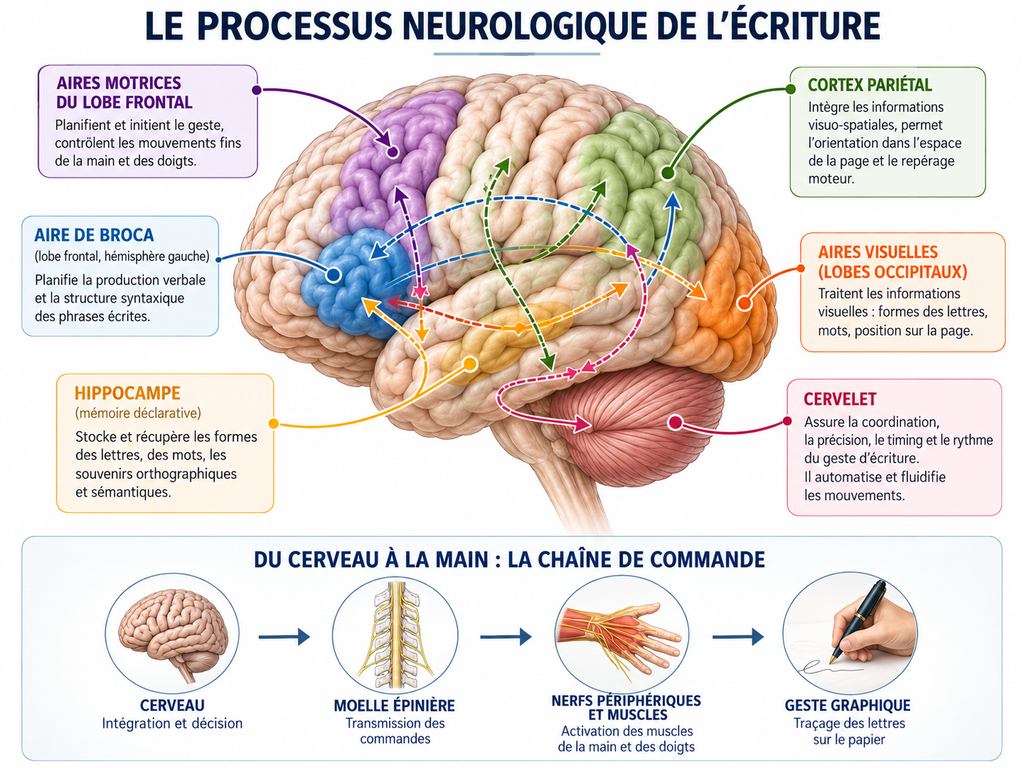
Figure 01 : Main brain regions involved in handwriting
The joint involvement of several cerebral networks goes some way to explaining the highly individual character of the writing movement and the persistence of graphic habits specific to each writer. This neurofunctional organisation also helps to explain why handwriting displays both stable characteristics, particular to the individual, and the natural variation inherent in any graphic act.
Fundamental principles of individuality and variability in handwriting
Forensic handwriting examination rests precisely on these two fundamental principles. On the one hand, handwriting is individual, which is what makes it unique. On the other, every writer displays a natural range of variation. It is the interplay between these two characteristics that allows the examiner to identify or eliminate the writer of a handwritten document.
The individuality of handwriting stems from the progressive automation of the writing movement. Although school instruction tends to impose a common copybook model, each individual, by virtue of his or her neurological, psychological and motor make-up, develops over time kinetic habits that are entirely his or her own. Identical twins may therefore share certain handwriting features, but their personal histories and neurological functioning introduce traits specific to each of them. Handwriting is thus the expression of a neuro-psychomotor automatism peculiar to each person. Stable yet individual, this acquired mechanism makes it possible to carry out comparisons for identification purposes.
This stability does not, however, mean that the writing movement is reproduced identically every time. No one signs or writes in exactly the same way on each occasion. Handwriting is naturally subject to variation arising from factors internal to the writer or from external causes. Physiological or psychological state, fatigue, age and emotional context, as well as writing position, the quality of the paper and the nature of the writing instrument, are all liable to affect the stability of the writing. These perfectly normal variations influence the written line without undermining the fundamental constants of the individual’s graphic automatism.
The examiner’s task is therefore to distinguish natural variations compatible with a common origin from divergences that reveal an inconsistency, which may in particular result from simulation or forgery. In other words, the examiner must separate normal fluctuations from incompatible discrepancies. Such an assessment requires a structured analytical methodology, based on rigorous criteria of observation, comparison and evaluation.
The ACE-V method applied to forensic handwriting examination
Forensic handwriting and document examination now follows a methodological approach modelled on that used in other forensic disciplines, notably the ACE-V method. Developed in the 1980s by David Ashbaugh, a Canadian fingerprint expert of international standing, this scientific method provides a rigorous analytical framework designed to structure the comparison process and lend it greater objectivity.
It comprises four successive stages, namely Analysis, Comparison, Evaluation and Verification.
Analysis:
This first stage involves analysing the questioned documents and the known specimens separately. The examiner assesses the quality of the writing and the quantity of graphic material available, that is, the volume of writing that can usefully be examined, while also examining the physical components of the document, such as the paper, the inks and all the technical and graphic characteristics of the writing. The paper and inks are examined using non-destructive optical techniques. Documents are viewed under light sources in the visible spectrum (380 nm to 780 nm) and in the ultraviolet and infrared ranges. Optical filters and varying angles of incidence, including oblique lighting, are also used to reveal features invisible to the naked eye.
This analytical phase seeks to identify the specific features of the writing movement, their intrinsic variability and their recurrence. Its main purpose is to assess the homogeneity of the writings under examination, in other words to determine whether the writings within a single body of material are consistent with a single writer.
To this end, a series of parameters are analysed and measured in turn: arrangement and layout, line density, baseline alignment, slant, the size and proportions of the letterforms, connecting strokes, line quality and dynamics, writing habits and letter design. All of these features are studied methodically, rigorously and systematically.
This stage of observation also serves to look for possible signs of disguise or simulation, such as unusually slow and unexplained execution, hesitations, pen stops, patching or retouching, and breaks in rhythm or fluency.
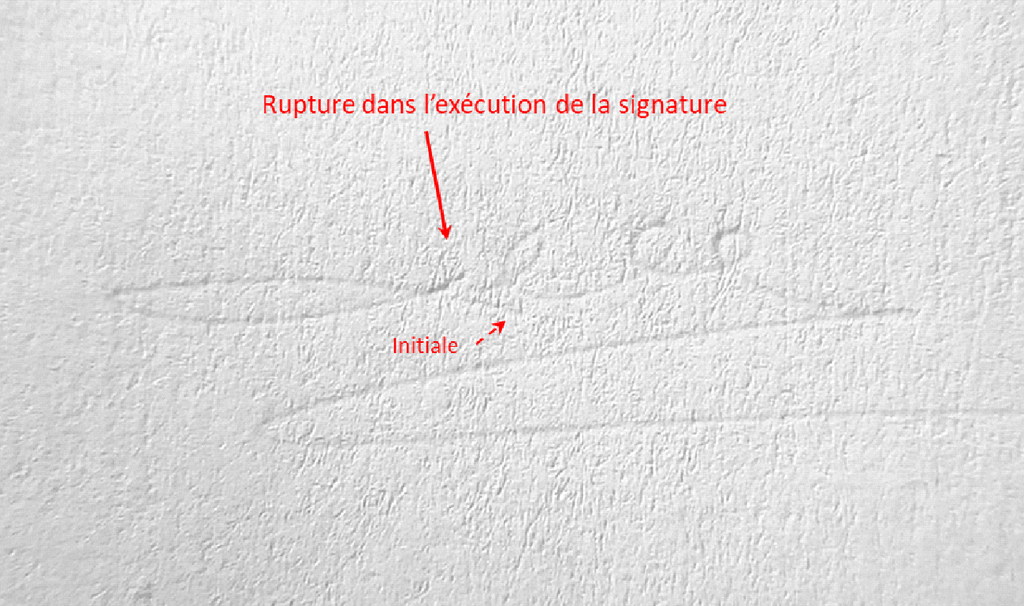
Figure 02 : Examination of pen pressure (MEPRI method). The perceptible stop in the pressure pattern reflects a hesitation in execution, frequently observed in forged writing.
Comparison:
Before comparing, the examiner must first assess the suitability of the reference material on which the comparison will rest. A usable body of comparison material must meet several essential requirements, both qualitative and quantitative. The specimens must be originals, contemporaneous with the questioned writings, sufficient in number, attributed with certainty to the writer concerned, naturally executed and written on a surface similar to that of the documents under examination. The strength of the conclusion depends directly on the suitability of the comparison material submitted for examination.
The characteristics observed in the questioned writings are then methodically compared with those found in the known specimens. This comparative analysis follows a strict, standardised protocol in which the observations progress from the general to the particular. The observations focus in particular on the specificity and the fine detail of the written line. These are individual, automated movements, most of them imperceptible to the naked eye, which an unskilled forger finds difficult to reproduce. It is precisely these distinctive features that the examiner sets out to bring to light.
They include the pressure applied to the writing instrument, which is a particularly strong identifying feature, and the barely perceptible micro-movements on the surface of the paper that can be observed at the beginning and end of the strokes, or between the strokes themselves. The examiner looks simultaneously for similarities and differences, assessing their nature, their frequency and their discriminating value.
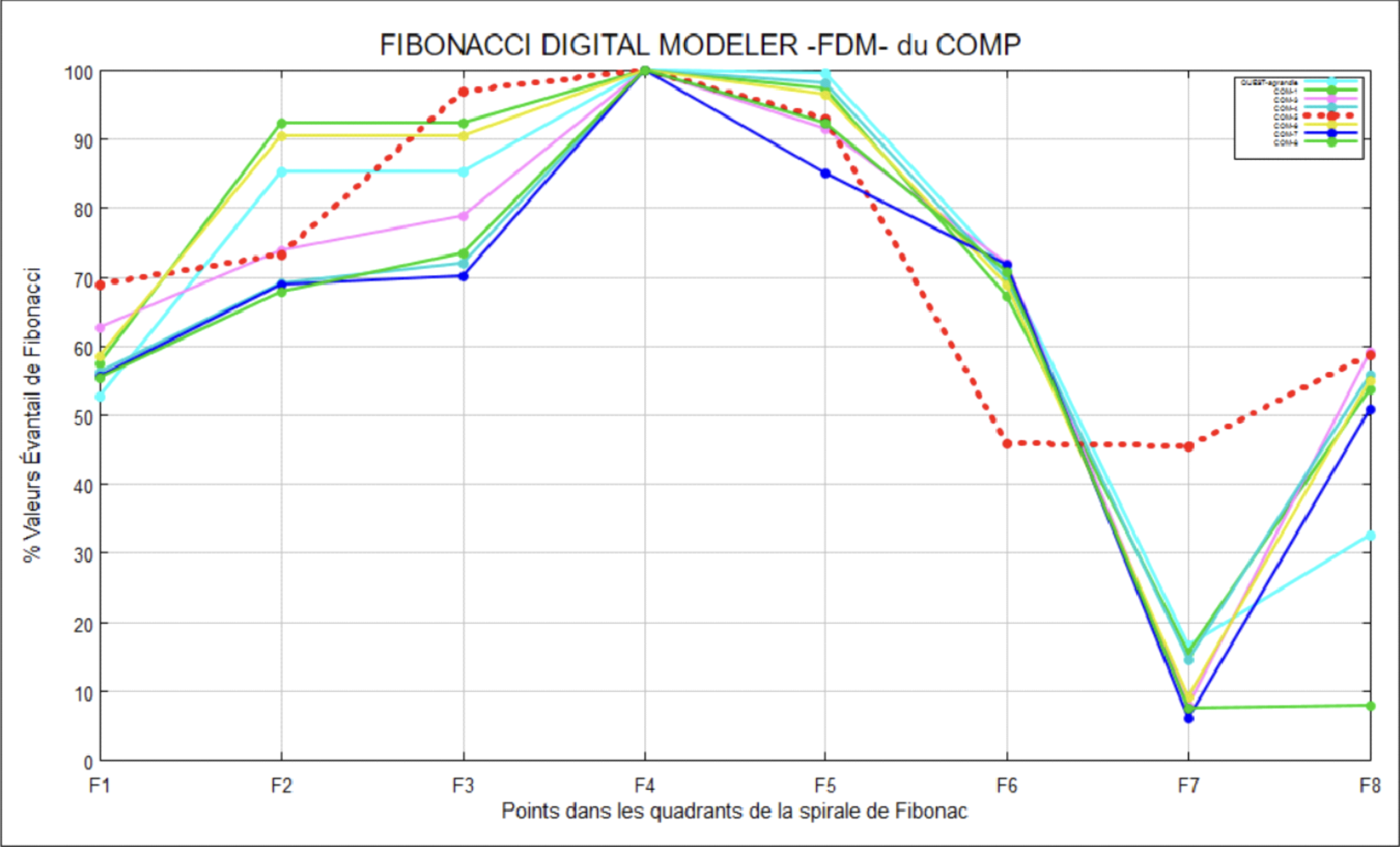
Figure 03 : Homothetic comparison of the internal structure of signatures (NEGA software). The homothetic profile of the questioned signature (red dotted line) is inconsistent with the reference signatures, indicating a graphic incompatibility that supports the hypothesis of a forged signature.
Evaluation:
The evaluation stage consists in weighing the significance of the findings. The examiner determines whether the similarities observed can objectively be attributed to the same writer. In a case of simulation, for example, similarities may be the result of deliberate copying and carry no weight. Conversely, where a writer denies authorship of a piece of writing, those same similarities may be relevant evidence of identification. In this respect, and following Edmond Locard, it bears repeating that “the clue must be interpreted”, since a trace only acquires meaning at the end of a contextual and reasoned analysis.
Differences, for their part, are interpreted in the light of the natural variation of handwriting. Attributing a piece of writing to its author rests on the absence of significant differences. The examiner therefore assesses the natural variation of the writing under study and sets it against the questioned documents, in order to determine whether the discrepancies observed are significant or not. This phase calls for a critical appraisal that takes into account the limitations of the material examined, as well as the quantity and quality of the comparison specimens available, so as to assess rigorously the scope and reliability of the findings.
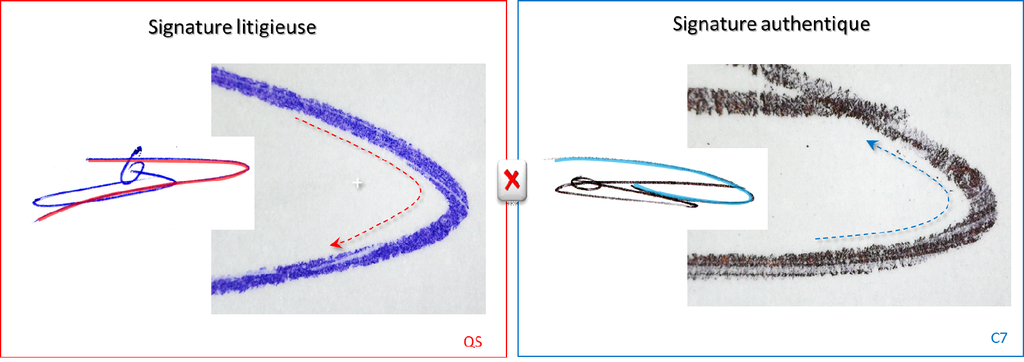
Figure 04 : Examination of the writing movement, clockwise in the questioned signature, anticlockwise in the genuine signatures. Analysis of the marks produced by the rotation of the pen, in particular the striations running from the inside outwards in the curved forms, reveals a writing movement that the forger neither perceived nor reproduced.
Verification:
The ACE-V method calls for a verification stage in which the case is re-examined by another qualified examiner, who applies the same methodology to the same documents with the same analytical means. This stage is intended to strengthen the reliability of the analysis and to limit the cognitive biases that can affect interpretation.
Applying the ACE-V model to forensic handwriting examination thus helps to anchor the discipline in a structured scientific approach. The methodology rests on the methodical observation of graphic traces, their reasoned comparison and the critical evaluation of the results obtained, all in the interest of objective expert conclusions. Like any scientific discipline, however, forensic handwriting and document examination depends on specific operating conditions. Where these are not met, the features observed may prove insufficient, much as an incomplete or damaged fingerprint cannot support a reliable identification.
The limitations and constraints of forensic handwriting and document examination
Like the other forensic disciplines based on the comparative analysis of traces, forensic handwriting examination has methodological and material limitations that oblige the examiner to frame conclusions with caution and restraint.
The main difficulties lie first and foremost in the quality and quantity of the writing submitted for examination. Badly degraded writing or paper, writing with little individual character, as is the case with some anonymous letters written in block capitals, or documents containing only a small number of characters, all considerably restrict the scope for analysis and identification. The use of copies, photographs or digital reproductions also entails the loss of information essential to the analysis. Certain decisive features, such as the speed of the writing movement, the pressure applied to the paper or the dynamics of the line, may become difficult or even impossible to assess objectively.
While an examination remains possible from a digital document, it is limited in scope and cannot rule out every form of falsification, in particular a composite produced by inserting the image of a genuine signature into a document. Some alterations can nonetheless be detected by examining the source file, notably through its metadata, the document properties or the consistency of the pixels.
A good-quality, first-generation photocopy can also yield useful evidence. Examining it makes it possible to assess the consistency of the printing, the quality of the images and the presence of any graphic anomalies. The absence of any detectable anomaly, however, does not permit a conclusion that the document is genuine, since some alterations may remain undetectable without the original.
In both cases, the digital document and the photocopy, the detection of technical or graphic inconsistencies is objective evidence capable of revealing a falsification. Examples include a low-resolution signature on a document that is otherwise of high image quality, or a signature which, under the microscope, proves to have been produced by colour inkjet printing while the rest of the document comes from a laser (toner-based xerographic) printer.
Non-original documents can also distort the true dimensions and proportions of the letters, particularly when the photographs were taken from an unsuitable angle, for example a tag written on the ground and photographed at 45 degrees. They can thus misrepresent the original graphic pattern by masking the writing movement, its direction, whether clockwise or anticlockwise, right to left or the reverse, and the number of pen lifts made during execution. Finally, reproductions can cause fine strokes to disappear or, conversely, artificially create spots, breaks or irregularities absent from the original document, compromising the reliability of the examination.
Examination of a non-original document, all the more so when it has passed through several generations of reproduction, does not always make it possible to determine whether a graphic element has been manipulated, for instance by cut-and-paste or image insertion.
The absence of the original document also deprives the examiner of several indispensable technical examinations, in particular the optical examinations systematically used to reveal signs of falsification such as retouching, added ink, mechanical erasures or chemical erasures.
The quality and relevance of the comparison material are decisive in any forensic handwriting examination, since they directly determine the scope of the comparative analysis and, in turn, the conclusions that can be drawn. Inadequate or quantitatively insufficient comparison material inevitably narrows the scope of the examination. How is one to compare a questioned signature when only a single known specimen is available? In practice, it cannot be done. The same applies when an examination has to rely on signatures that were not naturally written, or were even deliberately disguised, in which case the scope of the analysis is severely limited.
In such situations, a body of comparison material that is both plentiful and of suitable quality is essential in order to gauge the natural variation of the writing movement and to identify the graphic automatisms specific to the writer. A forger generally reproduces the most visible elements of the writing or signature, chiefly its overall form and certain morphological details. The same is true of a person seeking to disguise his or her writing, whose attention is focused mainly on the morphological aspects of the script.
Yet the most discriminating characteristics often lie in less perceptible elements, linked to the automation of the movement, its rhythm, its dynamics, its proportions (the relationships between its component parts) or the spatial organisation of the writing. The latter is strongly influenced by cues external to the writer, such as a box, a line or a typed entry, against which the writer spontaneously positions his or her writing or signature.
Only the examination of a sufficient number of genuine writings makes it possible to assess the permanence and variability of these characteristics and, consequently, to weigh the evidential value of the similarities and differences observed.
To these material constraints must be added intrinsic and extrinsic factors capable of significantly altering the writing movement, sometimes to the point of making it barely usable. Age, certain neurological conditions or tremors, fatigue, medication and postural constraints can all markedly change a person’s handwriting. Here again, strictly contemporaneous reference material, collected under conditions as close as possible to those of the questioned writings, is essential in order to judge whether the differences observed fall within the natural variation of the writing movement or reveal inconsistencies pointing to forgery.
An inconclusive result caused by qualitative or quantitative shortcomings should not be read as a weakness of the discipline, but as the expression of a rigorous scientific approach that respects the objective limits of the material examined. As Paul L. Kirk observed, the credibility of the forensic sciences rests as much on their ability to recognise their limits as on their ability to identify a trace or a writer.
Conclusion
Handwriting is thus a true forensic trace, the product of a complex and individual human process, on a par with the other physical evidence used in technical investigations. Its analysis relies on a rigorous methodology, grounded in scientific principles and in a structured comparative evaluation of the graphic characteristics observed.
Forensic handwriting and document examination is a constant balancing act between method, experience and interpretive caution. While frameworks such as the ACE-V method strengthen the reliability and objectivity of the examiner’s reasoning, the limitations inherent in the documents examined and in the comparison material call for a measured approach. The value of the discipline therefore lies in the examiner’s ability to consider the graphic evidence as a whole, in order to bring to the judicial debate an analysis that is reasoned, nuanced and scientifically founded.
Bibliographie :
Alain Buquet, L’expertise des écritures manuscrites, Masson, Paris, 1991
Pr. G. Serratrice et M. Habib, L’écriture et le cerveau. Mécanismes neurophysiologiques, Masson, Paris, 1993
Harralson H., Miller L., Huber and Headrick’s Handwriting Identification: Facts and Fundamentals, 2e éd., CRC Press, Boca Raton, 2018, ISBN 978-1-4987-5130-8
Hicklin R. A., Eisenhart L., Richetelli N. et al., « Accuracy and reliability of forensic handwriting comparisons », Proceedings of the National Academy of Sciences, 2022, vol. 119, n° 32, e2119944119, doi.org/10.1073/pnas.2119944119
Crot S., Marquis R., « A comparative review of error rates in forensic handwriting examination », Journal of Forensic Sciences, 2024, vol. 69, p. 2127-2138, doi.org/10.1111/1556-4029.15589
[1] French Order (arrêté) of 5 December 2022 on the nomenclature provided for in Article 1 of Decree No. 2004-1463 of 23 December 2004, https://www.cours-appel.justice.fr/sites/default/files/2023-02/arrete.pdf
[2] Pr. SERRATRICE et HABIB, L’écriture et le cerveau. Mécanismes neurophysiologiques, p. 1, MASSON.
[3] Mise en Évidence de la Pression avec Radiation IR. AIEED-2001
Tous droits réservés - © 2026 Forenseek