The identification of human remains belonging to missing persons continues to be a challenging process in forensic genetics. When an unidentified body or human remains are discovered, the most reliable method of identification is a comparison between the post-mortem DNA profile (obtained from biological tissue samples collected during the autopsy) and the ante-mortem DNA profile (typically obtained from the missing person’s personal belongings or from a prior medical sample) [1].
Some countries have established national missing persons identification programs using DNA analysis, which are highly effective when both the disappearance of individuals and the discovery of unidentified human remains occur within the same country. However, many investigations remain unsolved even after all domestic leads have been pursued.
International cooperation in missing persons investigations is therefore strongly recommended in light of increasing global migration, the growing impact of transnational crime and human trafficking, the vulnerability of migrants and refugees, and their heightened risk of becoming victims of criminal acts.
INTERPOL, the world’s largest international police organization, is mandated to take part in international investigations, including those involving missing persons, by connecting its 195 member countries. The Organization works primarily with national law enforcement agencies through the INTERPOL National Central Bureau (NCB) present in each country, but it can also cooperate with other international entities involved in disaster victim identification and missing persons cases. INTERPOL provides the legal framework and technical infrastructure for the secure exchange of information and access to its 19 databases, thereby enabling police worldwide to collaborate (Figure 1).
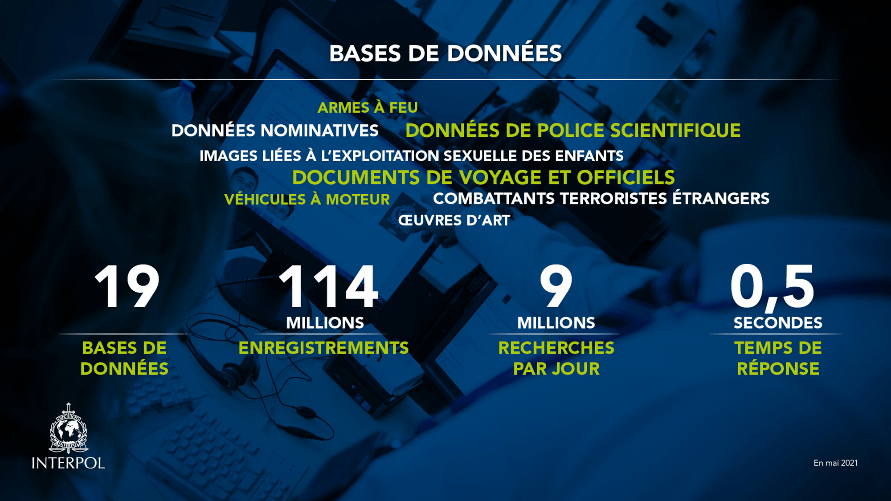
Figure 1: INTERPOL’s 19 databases. Credits: INTERPOL.
Created in 2002, INTERPOL’s DNA database currently contains more than 250,000 profiles provided by 86 member countries. National Central Bureaus and international entities can submit a DNA profile obtained from a suspect or convicted offender, from crime scenes, from missing persons, and from unidentified human remains, with an automated search result provided within minutes. No nominal data is attached to the profile, and member countries retain ownership of their information, in accordance with INTERPOL’s data processing rules. Countries can also choose with whom they wish to make their data available for comparison. INTERPOL’s DNA database has enabled investigators worldwide to link offenders to different types of crimes, including rape, murder, and armed robbery, as well as to formally identify missing persons found deceased outside their national borders from which they had been reported missing.
However, in many cases, direct DNA matches are not possible because ante-mortem DNA profiles are either unavailable or insufficient to confirm the identity of the missing person. This is often due to the inability to retrieve personal items (e.g., a toothbrush belonging to the missing person) or to access medical records that might contain relevant biological information. Consequently, in most cases, ante-mortem DNA data can only be obtained through the donation of biological samples by relatives genetically related to the missing person to the requesting authorities.
While most laboratories have the capacity and experience to perform relatively simple kinship tests, such as paternity testing, the evaluation of more complex kinship scenarios is far more challenging [2]. Specialized computer software is often required to compare ante-mortem and post-mortem data and to conduct complex kinship calculations using large DNA profile datasets. This software computes likelihood ratios (LR), which provide the optimal basis for statistical decision-making, regardless of whether or not there is an assumption about prior probabilities [3]. By using allele frequencies specific to the reference population to which the missing person belongs, the probability that a missing person could be part of a pedigree composed of family members whose DNA is available (e.g., parent, child, or sibling of the missing person) is assessed by comparing two hypotheses, H1 and H2. H1 supports that the individual belongs to the pedigree under study, while H2 supports that they are not related [2]. Although it is possible to implement this method within a national framework (kinship searching is used in several countries, including France, for example) where both the missing person and the unidentified human remains are reported in the same country, many challenges had to be addressed before applying this method in an international setting.
INTERPOL has addressed these challenges and, in June 2021, officially launched its 19th database, I-Familia, dedicated to the global identification of missing persons through DNA-based kinship analysis (Figure 2).
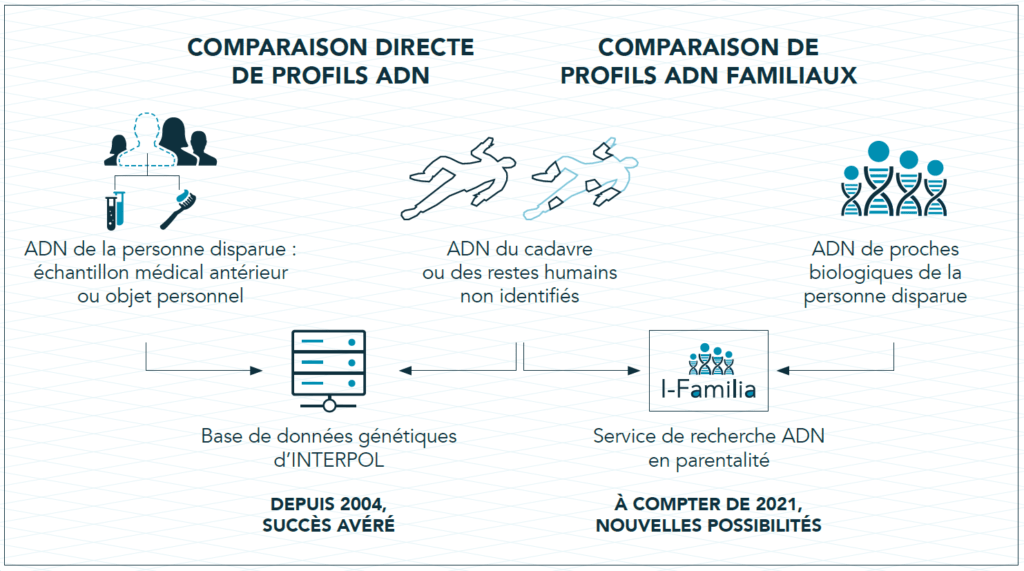
Figure 2: The DNA comparison process for missing persons investigations using INTERPOL’s DNA database and I-Familia. Credits: INTERPOL.
I-Familia is an innovative, free-of-charge service available to INTERPOL’s 195 member countries to help identify potential biological relationships between the DNA profiles of relatives of missing persons and unidentified human remains worldwide. I-Familia is characterized by three components. First, a dedicated DNA database that hosts the anonymous DNA profiles of biological relatives of missing persons and of unidentified human remains. This is a stand-alone database, separate from other INTERPOL databases containing criminal data. Second, the advanced BONAPARTE software [4], which is used to manage likelihood ratio calculations for any family pedigree using available DNA data (autosomal STR profiles, Y-STR, or mitochondrial DNA) against all DNA profiles from unidentified human remains. Third, scientifically validated interpretation rules [5] to assist users in interpreting statistical results and in the decision-making process that leads to either the rejection or the declaration of a potential biological relationship.
The statistical evaluation of whether a DNA profile belongs to a genetic pedigree requires the use of allele frequencies from a reference population. Since information on the genetic origin of individuals whose DNA is being studied is often missing or inaccurately reported, I-Familia enables likelihood ratio calculations using global allele frequencies [6], together with a correction factor to account for the degree of allele relatedness due to shared ancestry. To streamline the decision-making process and the assessment of potential biological relationships, extensive pedigree simulations were performed to accurately determine optimal likelihood ratio thresholds. Based on the ten most common scenarios encountered in missing persons investigations (depending on the availability of DNA profiles from biological relatives such as parents, children, or siblings) and the number of STR genetic markers comparable between profiles (ranging from 6 to 24 markers), likelihood ratio thresholds help limit the reporting of false positives while minimizing the rejection of false negatives. Interpretation tables, specifically designed to reflect the expected number of coincidental matches for each type of comparison, are extremely useful in determining the most appropriate decision (to assess the match, to reject it, or to request additional DNA information).
When the evidential value of the DNA study is sufficient and the ante-mortem and post-mortem data are compatible, a potential biological relationship report is sent to both data sources, which can then cooperate bilaterally to confirm the identification using their national procedures.
I-Familia has already enabled the identification of missing persons whose bodies were found in countries other than where they had been reported missing. The first confirmed match was made between the DNA profiles of the children of an Italian missing person and that of a body recovered in the Adriatic Sea by Croatian police in 2004, closing a case that had remained unresolved for nearly 16 years.
By the end of 2021, more than 12,000 active Yellow Notices—INTERPOL’s international police alerts for missing persons—had been issued by the General Secretariat, highlighting the need for greater international cooperation. I-Familia is a humanitarian tool that, thanks to INTERPOL’s global reach, opens up vast new possibilities for identifying missing persons and providing answers to families.
For further information on I-Familia, please consult the I-Familia brochure [7].
References:
- [1] Recommendations on the Use of DNA for the Identification of Missing Persons and Unidentified Human Remains by the INTERPOL DNA Monitoring Expert Group, (2017). http://www.interpol.int.
- [2] M.D. Coble, J. Buckleton, J.M. Butler, T. Egeland, R. Fimmers, P. Gill, L. Gusmão, B. Guttman, M. Krawczak, N. Morling, W. Parson, N. Pinto, P.M. Schneider, S.T. Sherry, S. Willuweit, M. Prinz, DNA Commission of the International Society for Forensic Genetics: Recommendations on the validation of software programs performing biostatistical calculations for forensic genetics applications, Forensic Sci. Int. Genet. 25 (2016) 191–197. https://doi.org/10.1016/j.fsigen.2016.09.002.
- [3] A. Collins, N.E. Morton, Likelihood ratios for DNA identification., Proc. Natl. Acad. Sci. 91 (1994) 6007–6011. https://doi.org/10.1073/pnas.91.13.6007.
- [4] https://www.bonaparte-dvi.com/
- [5] FX. Laurent, A. Fischer, R. Oldt, S. Kanthaswamy, J. Buckleton, S. Hitchin, Streamlining the decision-making process for international DNA kinship matching using worldwide allele frequencies and tailored cutoff log10LR thresholds, Forensic Sci. Int. Genet. 56 (2021). https://doi.org/10.1016/j.fsigen.2021.102634.
- [6] J. Buckleton, J. Curran, J. Goudet, D. Taylor, A. Thiery, B.S. Weir, Population-specific F values for forensic STR markers: A worldwide survey, Forensic Sci. Int. Genet. 23 (2016) 91–100. https://doi.org/10.1016/j.fsigen.2016.03.004.
Tous droits réservés - © 2026 Forenseek